South Andid Phenotype - Face Features & Origin
The southernmost Andid variety, somewhat influenced by Patagonid. The entry below collects the South Andid composite face, its documented distribution around 38.7° S, 72.3° W in South America, its physical characteristics, the research history behind the name, and the academic references that support all of it.
Average Face
The South Andid composite below is not a photograph of a real person. Historical anthropologists aligned multiple individual portraits from the South Andid reference population and averaged them into one image, so recurring structures — skull outline, nose form, lip thickness, brow position — dominate while individual idiosyncrasies cancel out.
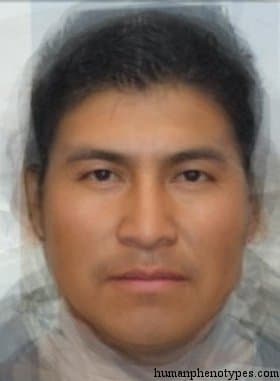
Composite source: Human Phenotypes — South Andid
Geographic Distribution
South Andid is documented across South America, with its historical reference center near 38.7° S, 72.3° W. The coordinates mark where the type was most characteristic roughly 1500 years ago; population movements since then have scattered and blended the distribution far beyond that point.
Physical Characteristics
Light olive-brown skin, straight, rarely wavy hair.
- Medium height, mesoskelic, endomorph and massive
- Meso- brachycephalic, mildly hypsicranic
- (Mildly) leptorrhine, relatively depressed nose
- Lips thin, Mongoloid eye features rare
- Often Europiform in expression
- In difference to other Andids, face lower, skin fairer, and nose narrower
Historical Background
The southernmost Andid variety, somewhat influenced by Patagonid. The dominant type in Mapuche, native to Chile. More mixed in the extinct Chonos of South Chile. Although disease reduced numbers drastically after contact with the Spanish, the type spread east across Patagonia until the 18th century during a process of Araucanisation, and gave rise to blends with Patagonids (Puelche, etc.).
Research History & Naming
Typological names were coined, contested, and renamed repeatedly across the 20th century, and South Andid is no exception. The extract below records the researchers who defined South Andid, the alternative labels it accumulated, and where the modern consensus settled.
After detailed earlier descriptions (e.g. Latcham, 1904 ; Ten Kate, 1906 ), Eickstedt (1934) and Drexel (1955) defined it as the southern Andid variety. Lundman (1967) regarded it a Patagonid-Andid blend. Generally included in Andid ( Kunter, 1987 ; Knussman, 1996 ) or together with Pubelid in Pueblo-Andid ( Imbelloni, 1952 ).
Comparison With Nearby Phenotypes
Ranked by great-circle distance from South Andid's reference center, these are the five nearest documented phenotypes — the closest being Pampid at 1,093 km. Overlapping distributions like these are exactly what makes the quiz hard, and the Pampid row is where to start looking.
| Phenotype | Region | Distance | Distinguishing trait |
|---|---|---|---|
| Pampid | South America | 1,093 km | Olive medium brown skin with straight and black rarely wavy hair. |
| Huarpid | South America | 1,294 km | Medium, sometimes dark brown skin, often with wavy hair. |
| Patagonid (proper) | South America | 1,462 km | Olive light brown skin, straight black, rarely wavy hair. |
| South Fuegid | South America | 1,783 km | Yellowish/reddish light brown skin with straight, rarely wavy, brown-black, sometimes blonde hair. |
| Central Andid | South America | 2,559 km | Medium olive-brown skin, straight, rarely wavy hair. |
South Andid in the Game
When the South Andid composite shows up in the quiz, players who know the South America distribution pattern have the edge. The reference answer sits near 38.7° S, 72.3° W; pins on the wrong continent score close to zero, so even a rough regional instinct beats a precise but misdirected pin.
South Andid Phenotype FAQ
- Where does the South Andid phenotype come from?
- The reference coordinates for the South Andid phenotype sit near 38.7° S, 72.3° W, in South America. That point marks the center of the South America distribution documented roughly 1500 years ago — actual prevalence spread well beyond it, toward entries such as Pampid 1,093 km away, and modern migration has blurred those boundaries further.
- What does the South Andid phenotype look like?
- In the historical literature, light olive-brown skin, straight, rarely wavy hair. For South Andid these are statistical tendencies across a population, not a checklist every individual matches.
- Is the South Andid phenotype a race or a nationality?
- No. Phenotypes like South Andid are descriptive averages, not ancestry groups. South Andid is one of several types documented in and around South America — see the comparison table above — and the same individual can carry traits associated with several of them at once. The South Andid entry describes a statistical pattern, not a group of people and not a nationality.
- How does South Andid appear in the game?
- In Classic Daily and Challenge Mode, the South Andid composite face appears without a label. Your task is to drop a pin on the world map where you think that face is historically most common — the scoring uses the distance between your pin and the reference coordinates near 38.7° S, 72.3° W. The post-round review then shows the correct location, your distance error, and this South Andid entry.
References & Literature
Every claim on this page traces back to the sources below — the researchers who defined, measured, and argued over the South Andid type. The originals behind the South Andid entry are worth consulting directly.
- Latcham, R. E. 1904. Notes on the Physial Characteristics of the Auraucanos. Journ. R. Anthr. Inst. 34. 170-180.
- Ten Kate, H. F. C. 1906. Matériaux pour servir à l'anthropologie des Indiens de la République Argentine. Rev. Mus. La Plata 12, 31-57.
- Eickstedt, E. von. 1934. Rassenkunde und Rassengeschichte der Menschheit. Ferdinand Enke. Stuttgart.
- Drexel, A. 1955. Die Völker der Erde. 2nd Ed. Akademie Verlag. Zürich.
- Lundman, B. 1967. Geographische Anthropologie. Rassen und Völker der Erde. G. Fischer, Stuttgart
- Kunter, M. 1987. Population and racial history of Argentina, Uruguay and Paraguay. In: Schwidetzky, I. Rassengeschischte des Menschheit 12.
- Knussmann, R. 1996. Vergleichende Biologie des Menschen: Lehrbuch der Anthropologie und Humangenetik. 2ed. Spektrum Akademischer Verlag.
- Imbelloni, J. 1952. Rassentypen und Biodynamik von Amerika. In: Historia Mundi. Band 1, Munich, 188-203.
Related Phenotypes
Other human phenotypes whose documented centers lie in the same part of the map as South Andid.
Pampid
South America · 1,093 km away
Slightly gracilised Patagonid variety, native to the vast plains of the Argentinian Chaco and Pampa. Sometimes mixed with Amazonid elements....
Huarpid
South America · 1,294 km away
Northern Fuegid variety that is often considered part of the Lagoid group. Shows Melanesiform features and probably arrived with one of the ...
Patagonid (proper)
South America · 1,462 km away
The most characteristic variety of the Patagonid group. Once dominated the cool grasslands of Patagonia. Was pushed back by Mapuche as well ...
South Fuegid
South America · 1,783 km away
The most characteristic Fuegid variety, adapted to the cool climate of Southern Chile. Named after Tierra del Fuego. Often considered part o...
Central Andid
South America · 2,559 km away
Andid variety, mostly native the Andes mountains from South Peru to Northern Chile. The large thorax and other traits indicate a significant...
Further Reading
Background articles from the blog that explain where the South Andid type fits, how these composites are built, and what a face can and cannot tell you.
The Evolutionary Story Behind Andean Faces
From round, heat-conserving faces above 3,500 meters to mixed-mestizo lowland populations, the skulls of the Andes are a lesson in...
What Ethnicity Do I Look Like? What a Face Can and Cannot Tell
The question assumes a face carries an ethnicity label. What it carries is a set of trait distributions that overlap heavily between...