South Fuegid Phenotype - Face Features & Origin
The most characteristic Fuegid variety, adapted to the cool climate of Southern Chile. The entry below collects the South Fuegid composite face, its documented distribution around 54.4° S, 67.6° W in South America, its physical characteristics, the research history behind the name, and the academic references that support all of it.
Average Face
The South Fuegid composite below is not a photograph of a real person. Historical anthropologists aligned multiple individual portraits from the South Fuegid reference population and averaged them into one image, so recurring structures — skull outline, nose form, lip thickness, brow position — dominate while individual idiosyncrasies cancel out.
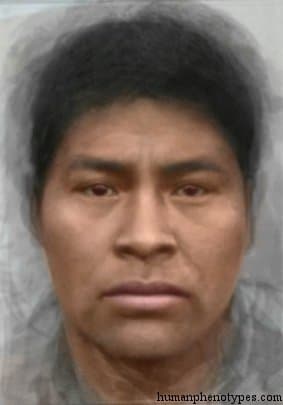
Composite source: Human Phenotypes — South Fuegid
Geographic Distribution
The reference center for South Fuegid sits near 54.4° S, 67.6° W in South America. Around that anchor, prevalence falls off gradually — the type is not confined to one valley or one modern border, and the historical map should be read as a gradient rather than a boundary.
Physical Characteristics
Yellowish/reddish light brown skin with straight, rarely wavy, brown-black, sometimes blonde hair.
- Short, meso- macroskelic, endomorph with long arms
- Dolicho- mesocephalic, rather large-headed, chamae- orthocranic with a mildly leptorrhine, low-rooted nose
- The forehead is narrow, face oblong, relatively high and rather small, supraorbital ridges not very developed
- Sometimes mild prognathy
Historical Background
The most characteristic Fuegid variety, adapted to the cool climate of Southern Chile. Named after Tierra del Fuego. Often considered part of the Lagoid group. Very ancient, probably arrived with one of the earliest migrations to America. The last survivors in the 20th century were Yaghan and Kawésqar. Their populations rapidly declined during the last decades, not more than 20 full-blooded remain today. Was also found in the extinct Chonos, Changos, and others.
Research History & Naming
The passage below traces who first defined South Fuegid, which rival names competed with it, and how later authors consolidated or disputed the classification — the raw material of any serious phenotype reference.
Split as Fuegid from Lagid proper by Imbelloni (1937) , Eickstedt (1952b) named its main variety South Fuegid. Generally used as Fuegid ( Canals Frau, 1950 ; Cerulli, 1967 ; Kunter, 1987 ), Biasutti (1967) and Drexel (1955) call it Magellanid. Part of Lagid ( Vogel, 1974; Knussmann, 1996 ). Detailed descriptions by Gusinde (1939) .
Comparison With Nearby Phenotypes
Geography, not alphabet, ordered this table: the five phenotype centers closest to South Fuegid's, with the traits most likely to be mistaken for it (Patagonid (proper) leads at 324 km). In gameplay, these five account for most of the wrong-but-nearby pins against South Fuegid.
| Phenotype | Region | Distance | Distinguishing trait |
|---|---|---|---|
| Patagonid (proper) | South America | 324 km | Olive light brown skin, straight black, rarely wavy hair. |
| South Andid | South America | 1,783 km | Light olive-brown skin, straight, rarely wavy hair. |
| Huarpid | South America | 2,309 km | Medium, sometimes dark brown skin, often with wavy hair. |
| Pampid | South America | 2,576 km | Olive medium brown skin with straight and black rarely wavy hair. |
| Central Andid | South America | 4,298 km | Medium olive-brown skin, straight, rarely wavy hair. |
South Fuegid in the Game
In gameplay terms, South Fuegid rewards region-level recall: the score is computed from the distance between your pin and 54.4° S, 67.6° W. Players often confuse South Fuegid with Patagonid (proper) (324 km out) in the comparison table above — those confusions are exactly what the distance penalty is designed to expose.
South Fuegid Phenotype FAQ
- Where does the South Fuegid phenotype come from?
- The reference coordinates for the South Fuegid phenotype sit near 54.4° S, 67.6° W, in South America. That point marks the center of the South America distribution documented roughly 1500 years ago — actual prevalence spread well beyond it, toward entries such as Patagonid (proper) 324 km away, and modern migration has blurred those boundaries further.
- What does the South Fuegid phenotype look like?
- In the historical literature, yellowish/reddish light brown skin with straight, rarely wavy, brown-black, sometimes blonde hair. For South Fuegid these are statistical tendencies across a population, not a checklist every individual matches.
- Is the South Fuegid phenotype a race or a nationality?
- No — and the South Fuegid naming history above shows why. South Fuegid was defined, renamed, and regrouped repeatedly by different researchers, which is the opposite of how a fixed racial category would behave. A phenotype is a recurring bundle of visible traits recorded across a population; the South Fuegid label says nothing about where any individual's ancestors were born.
- How does South Fuegid appear in the game?
- In Classic Daily and Challenge Mode, the South Fuegid composite face appears without a label. Your task is to drop a pin on the world map where you think that face is historically most common — the scoring uses the distance between your pin and the reference coordinates near 54.4° S, 67.6° W. The post-round review then shows the correct location, your distance error, and this South Fuegid entry.
References & Literature
The South Fuegid phenotype entry above is compiled from the 10 academic references. Readers are encouraged to consult the original South Fuegid sources for verification and deeper context.
- Imbelloni, J.. 1937. Fuéguides et Laguides. Position actuelle de la race Paleo-Américaine ou de antropologia fisica de la Patagonie austral. Zeitschrift für Rassenkunde 5, 295-315.
- Eickstedt, E. von. 1952. Biodynamik der Europiden. In: Historia Mundi. Band 1, Munich, 115-134.
- Coon, C. S., Garn, S. M. and Birdsell, J. B. 1950. Races: a Study of Race formation in Man. Charles C. Thomas. Springfield.
- Czekanowski, J.. 1967. Cz owiek w czasie i przestrzenie. Pa stwowe Wydawnictwo Naukowe. Warsaw.
- Kunter, M. 1987. Population and racial history of Argentina, Uruguay and Paraguay. In: Schwidetzky, I. Rassengeschischte des Menschheit 12.
- Biasutti, R. 1967 (1941). Le Razze e i Popoli della terra. 4th Ed. Vol 1-4. U.T.E.T., Torino.
- Dart, R. 1955. Three Strandloper from the Kaokoveld Coast. S. Afr. J. Sci 51. 175-179.
- Virchow, R. 1874. Die physische Anthropologie der Finnen. Verh. Berliner Ges. Anthr. Ethnol. Urg. VI. 185-189.
- Knussmann, R. 1996. Vergleichende Biologie des Menschen: Lehrbuch der Anthropologie und Humangenetik. 2ed. Spektrum Akademischer Verlag.
- Gusinde, M. 1939. Die Feuerland-Indiander. Die Anthropologie der Feuerland-Indianer, Vol 3.
Related Phenotypes
More entries from the same region of the historical map as South Fuegid, each with its own composite and trait profile.
Patagonid (proper)
South America · 324 km away
The most characteristic variety of the Patagonid group. Once dominated the cool grasslands of Patagonia. Was pushed back by Mapuche as well ...
South Andid
South America · 1,783 km away
The southernmost Andid variety, somewhat influenced by Patagonid. The dominant type in Mapuche, native to Chile. More mixed in the extinct C...
Huarpid
South America · 2,309 km away
Northern Fuegid variety that is often considered part of the Lagoid group. Shows Melanesiform features and probably arrived with one of the ...
Pampid
South America · 2,576 km away
Slightly gracilised Patagonid variety, native to the vast plains of the Argentinian Chaco and Pampa. Sometimes mixed with Amazonid elements....
Central Andid
South America · 4,298 km away
Andid variety, mostly native the Andes mountains from South Peru to Northern Chile. The large thorax and other traits indicate a significant...
Further Reading
Background articles from the blog that explain where the South Fuegid type fits, how these composites are built, and what a face can and cannot tell you.
The Evolutionary Story Behind Andean Faces
From round, heat-conserving faces above 3,500 meters to mixed-mestizo lowland populations, the skulls of the Andes are a lesson in...
Ethnicity Do I Look: A Question About Observers
The phrase is a fragment of a longer question, and its verb points at an observer, not at you. Perception research shows what observers...