Map Games for Adults: Four Formats and What Each Costs
Four map formats priced by the evening they fill, from five rounds of street deduction to a catalogue round whose answer is a citation, not a pin.
The unit you buy is the session
Comparisons of map games line up rounds, and almost nobody plays a round. They play for a while: one puzzle on a phone at a bus stop, five rounds at a desk between meetings, an hour in a room with three other people and a single screen. Two games with the same rules inside a round can cost entirely different evenings, and that cost decides whether the game survives past the first week far more reliably than the rules do.
Three quantities do most of the work. Minutes per round sets how many decisions you get for your time. Whether a round can be abandoned halfway decides whether the game fits a commute. Whether the score means anything across sessions decides whether it is worth keeping, and this is where formats quietly fail: a distance score on a random map is comparable between days, while a blank-map score is comparable only against the same list of questions. A commuting session holds eight to twelve minutes of attention at most, a desk session twenty, and a session in a room is an hour that includes arguing, which is a different activity from playing.
Five rounds of street-level deduction
The founding format hands you a panorama, lets you look around, and asks for one pin. Credit decays with distance, usually exponentially, and the shape of that decay matters more than its constant. Take a decay constant near 1,500 km: a guess 100 km off keeps 4,677 points of 5,000, one 1,000 km off keeps 2,566, and one 3,000 km off keeps 676. The first thousand kilometres are catastrophic and the last two thousand are nearly free.
That curve has a consequence for a group of adults. Because credit compresses as you approach the truth, a leaderboard of regular players is settled by two or three rounds in which somebody missed by under two hundred kilometres, and by almost nothing else. It also rewards the cheapest possible lesson: one distinguishable object, a pole, a plate, a painted line, narrows a continent faster than any amount of staring at the vegetation. Five rounds run six to eight minutes with loading. It is the most athletic format in the genre, and the least forgiving of a bad connection.
One puzzle a day and the lock
The daily format ships a single puzzle on a fixed date, scored once and not replayable for credit. Cost: under two minutes. The lock is the product rather than a restriction. It caps practice at one attempt per day, which keeps a casual player within reach of a committed one for months, and it makes the shared score mean something, because everyone met the same puzzle on the same morning.
The cost is a plateau and a finite pool. Three hundred and sixty-five puzzles a year is a small training set, and the answers do not renew themselves; a game built on country outlines will repeat eventually, and a repeat is visible immediately to anyone who played the first time. Daily formats are therefore edited rather than generated, and the editing is the operator's real work.
Blank-map recall and its ceiling
Name the country from an outline, place the river, fill the empty map. Twenty seconds an answer, the cheapest format to build and the fastest to play. It is also the format where prior knowledge settles the round before it starts: an adult who spent a decade with an atlas answers in three seconds and gains nothing from the exchange, while a beginner answers in forty and learns a shape.
A quiz measures retrieval and cannot measure inference, because there is nothing in front of you to infer from. Once the lookup table sits in memory the round is finished, and repetition adds no information to it. That asymmetry explains why blank maps are common in classrooms, where the table is still being built, and rare among the games adults return to without being asked.
A catalogue round with a citation as the answer
A fourth format asks you to place a documented appearance pattern instead of a place. The answer is an entry with an author, a year, a journal and a coordinate, so a wrong guess can be argued with rather than simply scored. Reading the entry takes two to four minutes, and the reading is the round; the guess is the small part at the end of it.
In a room, this changes the social shape. A distance score produces silence and then a number, and the number ends the conversation. An entry produces disagreement about which feature was decisive, which is something four people at one table can do together, and it lets the losing side be right about a detail even after losing the round. The argument outlives the score, and that is the difference between a game people return to and a game people finish once.
Where the answer sheet is younger than the map
The Chile-Argentina boundary follows a watershed principle agreed in an 1881 treaty and settled by arbitration in 1902. Patagonid proper once dominated the cool grasslands on both sides of that line, and South Andid spread east across the Andes during the Araucanisation that ran into the eighteenth century. A border-recall game scores those entries against a line drawn after the distributions it is asking about.
The mismatch is the normal case rather than an edge case. Inuid runs from Alaska through Nunavut and Labrador to Greenland, four jurisdictions for one entry, with the Inughuit of North Greenland recorded as its northernmost group. Central Andid runs from southern Peru into northern Chile, typified by Aymara speakers whose presence predates the border by centuries. Asked where a pattern belongs, both sides is often the accurate answer.
Picking by the evening you have
The four formats differ less in difficulty than in what they waste, and the waste shows up on the first evening rather than the tenth. Matching a format to a night is mostly a matter of counting minutes and people before pressing start. The format that suits a solo commute is often the one that ruins a table of four, since a locked daily gives a room nothing to argue about, and a blank map gives it nothing to look at. A rough allocation by time and company:
- Under five minutes, alone: the daily lock, which fits a queue and cannot swallow an afternoon.
- Five to ten minutes with one other person: street-level deduction, where the argument over a road sign is the point.
- A blank map only if somebody in the room is still learning the map, otherwise it is a typing test with scenery.
- An hour with a table: the catalogue round, because a citation can be discussed and a coordinate cannot.
Frequently Asked Questions
- What is a good map game for adults who are not geography experts?
- Start with a daily puzzle rather than a blank map. A daily gives everyone the same single answer once a day, takes under two minutes, and does not reward the person with the largest stock of memorised capitals. Formats scored by distance are also forgiving rather than binary, so a reasonable guess still pays something. Avoid the outline quizzes at first: they measure retrieval, and retrieval is exactly what a beginner has least of. The test of a good format is whether you learn one thing from a wrong answer.
- How long does a round of a map game usually take?
- It depends entirely on the format, which is why round counts are a bad way to compare games. A street-level panorama rewards looking around and typically runs one to two minutes; five such rounds make a session of six to eight minutes. A single daily puzzle takes under two minutes and locks until tomorrow. A blank-map question is over in about twenty seconds. A catalogue round costs two to four minutes because the reading is the round, not a delay before it.
- Can a map game tell you someone's ethnicity?
- No, and the formats that appear to are answering a narrower question. A portrait round asks which of a fixed list of composite faces a photograph most resembles, which is a similarity ranking over images someone else assembled. The catalogue behind this site describes documented appearance patterns with historical distributions, roughly 1500 years old, each attached to an author and a coordinate. Neither operation returns a person's ancestry, nationality or identity, and a game score cannot be promoted into one.
Related Phenotypes
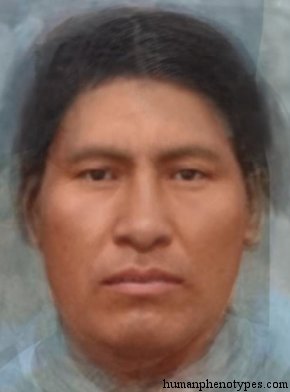
Faces from the encyclopedia that appear in this article. Open any entry for its full description, distribution, and references.
Patagonid (proper)
South America
The most characteristic variety of the Patagonid group. Once dominated the cool grasslands of Patagonia. Was pushed back by Mapuche as well ...
South Andid
South America
The southernmost Andid variety, somewhat influenced by Patagonid. The dominant type in Mapuche, native to Chile. More mixed in the extinct C...
Inuid
Arctic
Eskimid proper type, ranging over the vast, sparsely populated tundra along the icy coasts of Alaska, Nunavut, and Labrador (Canada) to Gree...
Central Andid
South America
Andid variety, mostly native the Andes mountains from South Peru to Northern Chile. The large thorax and other traits indicate a significant...
Test what you learned
Put your eye for regional faces to work in the daily quiz — a composite face, a world map, and your best guess.