West Amazonid Phenotype - Face Features & Origin
Historical anthropology places the West Amazonid phenotype in South America, with a documented center near 5.0° S, 75.0° W. Amazonid subtype, the most frequent type in the Western Amazon rainforest. The sections that follow unpack the West Amazonid entry in practice: the composite face, the traits it summarizes, the naming history, and the sources.
Average Face
Averaging the portraits behind West Amazonid leaves the features that repeat and erases the ones that do not. That is exactly how the West Amazonid composite below was built: individual photographs were aligned and statistically merged, exaggerating shared structure into a single reference face that no actual person looks like.
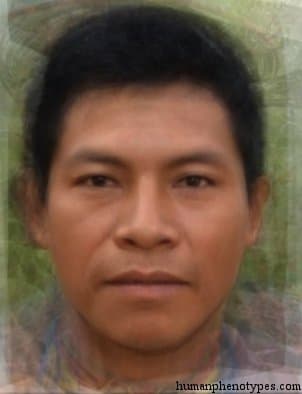
Composite source: Human Phenotypes — West Amazonid
Geographic Distribution
Geographically, West Amazonid anchors to 5.0° S, 75.0° W (South America). That is the point where historical anthropologists judged West Amazonid most concentrated, not a hard edge; modern migration and intermarriage have long since softened whatever boundaries once existed.
Physical Characteristics
Medium (yellowish/reddish) brown skin.
- Straight or slightly wavy hair
- (Rather) short, macro- mesoskelic, ectomorph to endomorph
- Mesocephalic, sometimes brachycephalic, mildly hypsicranic
- Meso-, sometimes platyrrhine nose
- Face oval with relatively soft features, broad forehead, slightly receding chin
- Eyes slanting, Mongolian fold rare
Historical Background
Amazonid subtype, the most frequent type in the Western Amazon rainforest. Common among Arawakan speakers, typical groups are Yawalapiti, Asháninka, Mashco-Piro, Piapoco, Wayuu, among others. Possibly originated in Colombian savannahs and expanded to the Caribbean and Amazonia, where older Lagoid elements were assimilated. Has partially been pushed back by North Amazonids and Isthmids in the centuries prior to European contact.
Research History & Naming
Typological names were coined, contested, and renamed repeatedly across the 20th century, and West Amazonid is no exception. The extract below records the researchers who defined West Amazonid, the alternative labels it accumulated, and where the modern consensus settled.
Has been described as the western group of Brasilid by Eickstedt (1934) like Lundman (1967) , who called it Amazonid, which is synonymous and was also used by Imbelloni (1952) and Kunter (1987) . Imbelloni (1958) regarded the western Amazonids to overlap with a Lago-Fuegid substratum.
Comparison With Nearby Phenotypes
Ranked by great-circle distance from West Amazonid's reference center, these are the five nearest documented phenotypes — the closest being North Andid at 1,003 km. Overlapping distributions like these are exactly what makes the quiz hard, and the North Andid row is where to start looking.
| Phenotype | Region | Distance | Distinguishing trait |
|---|---|---|---|
| North Andid | South America | 1,003 km | Medium, sometimes dark olive-brown skin with straight, sometimes wavy hair. |
| Chocó-Motilon | South America | 1,203 km | Medium brown skin with straight or wavy hair. |
| Central Andid | South America | 1,330 km | Medium olive-brown skin, straight, rarely wavy hair. |
| Isthmid | South America | 1,654 km | Medium (yellowish) brown skin, straight or slightly wavy hair. |
| Bororo | South America | 1,755 km | Olive medium brown skin with straight and black rarely wavy hair. |
West Amazonid in the Game
When the West Amazonid composite shows up in the quiz, players who know the South America distribution pattern have the edge. The reference answer sits near 5.0° S, 75.0° W; pins on the wrong continent score close to zero, so even a rough regional instinct beats a precise but misdirected pin.
West Amazonid Phenotype FAQ
- Where does the West Amazonid phenotype come from?
- Historical sources center the West Amazonid phenotype on 5.0° S, 75.0° W (South America). Treat that as a rough anchor: the type appeared across a wider surrounding area — its nearest documented neighbors, North Andid and Chocó-Motilon, sit 1,003 and 1,203 km from the reference point — and its present-day distribution no longer matches the historical map.
- What does the West Amazonid phenotype look like?
- The composite emphasizes recurring traits: medium (yellowish/reddish) brown skin. The full trait list for West Amazonid appears in the physical characteristics section above.
- Is the West Amazonid phenotype a race or a nationality?
- No. Phenotypes like West Amazonid are descriptive averages, not ancestry groups. West Amazonid is one of several types documented in and around South America — see the comparison table above — and the same individual can carry traits associated with several of them at once. The West Amazonid entry describes a statistical pattern, not a group of people and not a nationality.
- How does West Amazonid appear in the game?
- When the West Amazonid face comes up in Classic Daily or Challenge Mode, you pin the world map where you believe the type is historically most common, and the score decays with your distance to 5.0° S, 75.0° W. The nearest documented type, North Andid, lies about 1,003 km away, so regional placement usually carries most of the score.
References & Literature
Every claim on this page traces back to the sources below — the researchers who defined, measured, and argued over the West Amazonid type. The originals behind the West Amazonid entry are worth consulting directly.
- Eickstedt, E. von. 1934. Rassenkunde und Rassengeschichte der Menschheit. Ferdinand Enke. Stuttgart.
- Lundman, B. 1967. Geographische Anthropologie. Rassen und Völker der Erde. G. Fischer, Stuttgart
- Imbelloni, J. 1952. Rassentypen und Biodynamik von Amerika. In: Historia Mundi. Band 1, Munich, 188-203.
- Kunter, M. 1987. Population and racial history of Argentina, Uruguay and Paraguay. In: Schwidetzky, I. Rassengeschischte des Menschheit 12.
- Imbelloni, J. 1958. Nouveaux apports à la classification de l'homme américain. Miscellanea P. Rivet octogenario dicata. Mexico.
Related Phenotypes
If West Amazonid interested you, these neighboring phenotype entries cover adjacent parts of the map with distinctly different trait bundles.
North Andid
South America · 1,003 km away
The most important and numerous Andid subvariety, adapted to the high altitudes of the Peruvian and Ecuadorian Andes. Typified by Quechua. T...
Chocó-Motilon
South America · 1,203 km away
Special type found in Colombia, Venezuela, as well as Panama. Contains Brasilid elements as well as relicts of one of the first migrations t...
Central Andid
South America · 1,330 km away
Andid variety, mostly native the Andes mountains from South Peru to Northern Chile. The large thorax and other traits indicate a significant...
Isthmid
South America · 1,654 km away
Centralid subtype, that has partially adapted to the tropical forests of the Isthmus of Panama and the surrounding regions from Colombia to ...
Bororo
South America · 1,755 km away
The northernmost Patagonid variety, often mixed with local Lagid elements, but with a variety of unique features. Native to the savannah and...
Further Reading
Background articles from the blog that explain where the West Amazonid type fits, how these composites are built, and what a face can and cannot tell you.
Ethnic Guesser: Which Facial Cues Actually Decide a Round
A round of the game turns on a handful of facial cues, and they are not equal. Here is how pigment, the epicanthic fold, nasal shape...
What Ethnicity Am I? Three Ways to Actually Answer It
The question is personal, but the answers arrive from three different places: records, DNA, and appearance. Each can tell you something...