Saharan Ethiopid Phenotype - Face Features & Origin
Ethiopid type that was more common during the Neolithic when the Sahara was still green. The entry below collects the Saharan Ethiopid composite face, its documented distribution around 21.4° N, 17.5° E in West Africa, its physical characteristics, the research history behind the name, and the academic references that support all of it.
Average Face
The Saharan Ethiopid composite below is not a photograph of a real person. Historical anthropologists aligned multiple individual portraits from the Saharan Ethiopid reference population and averaged them into one image, so recurring structures — skull outline, nose form, lip thickness, brow position — dominate while individual idiosyncrasies cancel out.
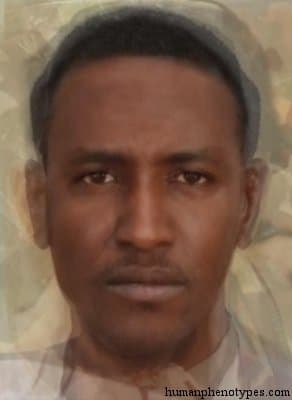
Composite source: Human Phenotypes — Saharan Ethiopid
Geographic Distribution
Saharan Ethiopid is documented across West Africa, with its historical reference center near 21.4° N, 17.5° E. The coordinates mark where the type was most characteristic roughly 1500 years ago; population movements since then have scattered and blended the distribution far beyond that point.
Physical Characteristics
Reddish brown-black skin, tight-curly hair.
- Rather tall, brachyskelic, ectomorph
- Dolicho- mesocephalic, mildly hypsicranic
- Nose mesorrhine, slightly depressed with a relatively high back
- Face is broad and low with angular features
- Eyelid openings are usually narrow
Historical Background
Ethiopid type that was more common during the Neolithic when the Sahara was still green. Today it extends from Chad to Niger, Northern Nigeria and even Cameroon. Found in its purest form in the Toubou of the Tibesti mountains in Northern Chad. More mixed in Hausa, Iravellans of the Tuareg, Kanembu, Buduma, Zande, Fur, even Eton.
Research History & Naming
Typological names were coined, contested, and renamed repeatedly across the 20th century, and Saharan Ethiopid is no exception. The extract below records the researchers who defined Saharan Ethiopid, the alternative labels it accumulated, and where the modern consensus settled.
Biasutti (1967) considered it a separate Ethiopoid branch "Sahariana". Has been described as West Ethiopid together with Fulani and Moors ( Baumann, 1952 ) or as Central Ethiopid ( Eickstedt, 1943 ). Even Knussmann (1996) places it in Ethiopid. Noel (1920) noted that its different components cannot be isolated anymore and that it is stabilised. Lundman (1967) considered it an admixed Saharid.
Comparison With Nearby Phenotypes
Geography, not alphabet, ordered this table: the five phenotype centers closest to Saharan Ethiopid's, with the traits most likely to be mistaken for it (Fezzanid leads at 586 km). In gameplay, these five account for most of the wrong-but-nearby pins against Saharan Ethiopid.
| Phenotype | Region | Distance | Distinguishing trait |
|---|---|---|---|
| Fezzanid | North Africa | 586 km | Light to dark brown skin, curly to kinky hair. |
| Libyid | North Africa | 607 km | Light brown skin, often wavy black hair. |
| Paleo Saharid | North Africa | 798 km | Medium brown, sometimes yellowish skin. |
| Siwa | North Africa | 1,183 km | Light to medium brown skin, often wavy, sometimes tight-curly black hair. |
| Shari | West Africa | 1,194 km | (Bluish/greyish) black skin, usually kinky hair. |
Saharan Ethiopid in the Game
In gameplay terms, Saharan Ethiopid rewards region-level recall: the score is computed from the distance between your pin and 21.4° N, 17.5° E. Players often confuse Saharan Ethiopid with Fezzanid (586 km out) in the comparison table above — those confusions are exactly what the distance penalty is designed to expose.
Saharan Ethiopid Phenotype FAQ
- Where does the Saharan Ethiopid phenotype come from?
- Historical sources center the Saharan Ethiopid phenotype on 21.4° N, 17.5° E (West Africa). Treat that as a rough anchor: the type appeared across a wider surrounding area — its nearest documented neighbors, Fezzanid and Libyid, sit 586 and 607 km from the reference point — and its present-day distribution no longer matches the historical map.
- What does the Saharan Ethiopid phenotype look like?
- The composite emphasizes recurring traits: reddish brown-black skin, tight-curly hair. The full trait list for Saharan Ethiopid appears in the physical characteristics section above.
- Is the Saharan Ethiopid phenotype a race or a nationality?
- No. A phenotype is a recurring bundle of visible traits documented by historical anthropologists across a population — for Saharan Ethiopid, patterns such as reddish brown-black skin, tight-curly hair. The Saharan Ethiopid entry is not a genetic ancestry, not a nationality, and not a statement about any individual person. Two people from the same country can match completely different phenotypes — one resembling Saharan Ethiopid, another closer to Fezzanid — and one phenotype can span many modern borders.
- How does Saharan Ethiopid appear in the game?
- When the Saharan Ethiopid face comes up in Classic Daily or Challenge Mode, you pin the world map where you believe the type is historically most common, and the score decays with your distance to 21.4° N, 17.5° E. The nearest documented type, Fezzanid, lies about 586 km away, so regional placement usually carries most of the score.
References & Literature
Every claim on this page traces back to the sources below — the researchers who defined, measured, and argued over the Saharan Ethiopid type. The originals behind the Saharan Ethiopid entry are worth consulting directly.
- Biasutti, R. 1967 (1941). Le Razze e i Popoli della terra. 4th Ed. Vol 1-4. U.T.E.T., Torino.
- Baumann, H.. 1952. Die Rassen Afrikas. In: Historia Mundi. Band 1, Munich, 167-174.
- Eickstedt, E. von. 1943. Völkerbiologische Probleme der Sahara. In: Beiträge zur Kolonialforschung. Tagungsband I, 169-240.
- Knussmann, R. 1996. Vergleichende Biologie des Menschen: Lehrbuch der Anthropologie und Humangenetik. 2ed. Spektrum Akademischer Verlag.
- Noel, P.. 1920. Etude éthnographoque et anthropologique sur les Tédas. L'Anthr. XXX. 115-133.
- Lundman, B. 1967. Geographische Anthropologie. Rassen und Völker der Erde. G. Fischer, Stuttgart
Related Phenotypes
Other human phenotypes whose documented centers lie in the same part of the map as Saharan Ethiopid.
Fezzanid
North Africa · 586 km away
Saharan type combining ancient elements including Berberid with sub-Saharan elements that often entered the region during the Middle Ages. C...
Libyid
North Africa · 607 km away
North African steppe type that is usually regarded as part of Orientalid. Although Arab invasions enhanced the Orientalid element in Africa ...
Paleo Saharid
North Africa · 798 km away
Very ancient type native to the Sahara Desert. Related to Proto Ethiopid, but possibly also shows traces of ancient Khoisanids who were more...
Siwa
North Africa · 1,183 km away
Distinctive Berber type typical for the Eastern Sahara Desert. Typified by the population of the Siwa and Awjila oases of Northwestern Egypt...
Shari
West Africa · 1,194 km away
Special type named after the Chari river of Chad. Intermediate between Sudanid and Nilotid, but with several unique features that have long ...
Further Reading
Background articles from the blog that explain where the Saharan Ethiopid type fits, how these composites are built, and what a face can and cannot tell you.
Ethnicity Guesser Photo: What Happens to the File First
A photo handed to a face tool stops being a photograph almost at once: the file is decoded, rotated, colour-converted and resized before...
Ethnicity Quiz: Five Question Types Behind the Label
A face quiz, a census form, a reaction-time experiment, a surname model and an ancestry report all answer to the same phrase.