Siwa Phenotype - Face Features & Origin
Historical anthropology places the Siwa phenotype in North Africa, with a documented center near 29.2° N, 25.5° E. Distinctive Berber type typical for the Eastern Sahara Desert. The sections that follow unpack the Siwa entry in practice: the composite face, the traits it summarizes, the naming history, and the sources.
Average Face
Averaging the portraits behind Siwa leaves the features that repeat and erases the ones that do not. That is exactly how the Siwa composite below was built: individual photographs were aligned and statistically merged, exaggerating shared structure into a single reference face that no actual person looks like.
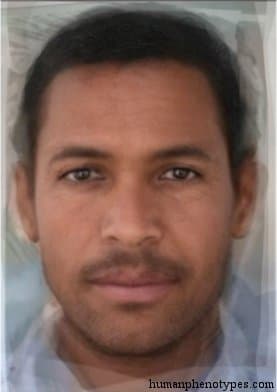
Composite source: Human Phenotypes — Siwa
Geographic Distribution
The reference center for Siwa sits near 29.2° N, 25.5° E in North Africa. Around that anchor, prevalence falls off gradually — the type is not confined to one valley or one modern border, and the historical map should be read as a gradient rather than a boundary.
Physical Characteristics
Light to medium brown skin, often wavy, sometimes tight-curly black hair.
- Rather short, mesoskelic, mesomorph to ectomorph
- (Hyper-)dolichocephalic, chamae- orthocranic with short face
- Mildly leptorrhine, short and depressed nose
- Body hair rather scant
- Chin and brow ridges weak
Historical Background
Distinctive Berber type typical for the Eastern Sahara Desert. Typified by the population of the Siwa and Awjila oases of Northwestern Egypt. In lower frequencies extends to Jalu (Libya) and other Egyptian oases (Kharga). In the latter, it is transitional to the Nubian type. Rare outside of the desert.
Research History & Naming
The passage below traces who first defined Siwa, which rival names competed with it, and how later authors consolidated or disputed the classification — the raw material of any serious phenotype reference.
Coon (1939) described the type as an extreme Mediterranean, Biasutti (1967) as a relict of an ancient ethnic defeat. Detailed analysis by Cline (1932) . Dugoujon et al. (2009) found Siwans to be genetically the most differentiated Berber population.
Comparison With Nearby Phenotypes
The five phenotypes whose documented centers lie closest to Siwa, ranked by great-circle distance. They are the types players most often confuse with Siwa in the quiz, precisely because their distributions overlap.
| Phenotype | Region | Distance | Distinguishing trait |
|---|---|---|---|
| Libyid | North Africa | 768 km | Light brown skin, often wavy black hair. |
| Egyptid | North Africa | 807 km | Light brown skin, wavy or curly black hair. |
| Gracile Mediterranid | Southern Europe | 998 km | Light brown skin, straight to wavy, rarely curly, usually abundant brown to brown-black hair. |
| Litorid | Middle East | 1,024 km | Light brown skin. |
| Eurafricanid | Southern Europe | 1,043 km | Light brown skin, straight to curly, usually dark brown hair. |
Siwa in the Game
Siwa is one of the faces that can appear in Classic Daily and Challenge Mode. When it does, the winning pin lands near 29.2° N, 25.5° E in North Africa — and because the scoring decays with distance, recognizing the region matters more than pixel-perfect placement.
Siwa Phenotype FAQ
- Where does the Siwa phenotype come from?
- The reference coordinates for the Siwa phenotype sit near 29.2° N, 25.5° E, in North Africa. That point marks the center of the North Africa distribution documented roughly 1500 years ago — actual prevalence spread well beyond it, toward entries such as Libyid 768 km away, and modern migration has blurred those boundaries further.
- What does the Siwa phenotype look like?
- In the historical literature, light to medium brown skin, often wavy, sometimes tight-curly black hair. For Siwa these are statistical tendencies across a population, not a checklist every individual matches.
- Is the Siwa phenotype a race or a nationality?
- No — and the Siwa naming history above shows why. Siwa was defined, renamed, and regrouped repeatedly by different researchers, which is the opposite of how a fixed racial category would behave. A phenotype is a recurring bundle of visible traits recorded across a population; the Siwa label says nothing about where any individual's ancestors were born.
- How does Siwa appear in the game?
- In Classic Daily and Challenge Mode, the Siwa composite face appears without a label. Your task is to drop a pin on the world map where you think that face is historically most common — the scoring uses the distance between your pin and the reference coordinates near 29.2° N, 25.5° E. The post-round review then shows the correct location, your distance error, and this Siwa entry.
References & Literature
The Siwa phenotype entry above is compiled from the 4 academic references. Readers are encouraged to consult the original Siwa sources for verification and deeper context.
- Coon, C.S.. 1939.. The Races of Europe. The Macmillan Company. New York.
- Biasutti, R. 1967 (1941). Le Razze e i Popoli della terra. 4th Ed. Vol 1-4. U.T.E.T., Torino.
- Cline, W. 1932. Anthropometric notes on the natives of Siwah Oasis.
- D09
Related Phenotypes
More entries from the same region of the historical map as Siwa, each with its own composite and trait profile.
Libyid
North Africa · 768 km away
North African steppe type that is usually regarded as part of Orientalid. Although Arab invasions enhanced the Orientalid element in Africa ...
Egyptid
North Africa · 807 km away
Libyid variety, typical for the Nile Valley of Egypt. May result from ancient South/West Asian migrations that mixed with native Berberids. ...
Gracile Mediterranid
Southern Europe · 998 km away
Mediterranid proper, smaller than other Mediterranids: the most gracile type of Europe. Appears first in Mesolithic groups of Palestine (Nat...
Litorid
Middle East · 1,024 km away
Type of coastal European regions that contains Mediterranid and Dinaro-Armenid elements. Probably the result of ancient migrations from Asia...
Eurafricanid
Southern Europe · 1,043 km away
Atlanto Mediterranid proper type. Relatively old, present in early Natufians and European as well as North African megalith builders. Spread...
Further Reading
Background articles from the blog that explain where the Siwa type fits, how these composites are built, and what a face can and cannot tell you.
Is AI Ethnicity Guessing Accurate? Separating the Marketing From the Measurements
Published accuracies for AI face-based ancestry classification range from 80 to 99 percent - under lab conditions that real faces never...
Ethnicity From a Face: Which Layer Carries the Signal
A face is not one trait but a stack of layers, and asking a photograph for ethnicity from face assumes every one of those layers tells...