Toda Phenotype - Face Features & Origin
Historical anthropology places the Toda phenotype in South Asia, with a documented center near 11.4° N, 76.7° E. Indid subtype, native to the Nilgiri Hills of Southern India. The sections that follow unpack the Toda entry in practice: the composite face, the traits it summarizes, the naming history, and the sources.
Average Face
Averaging the portraits behind Toda leaves the features that repeat and erases the ones that do not. That is exactly how the Toda composite below was built: individual photographs were aligned and statistically merged, exaggerating shared structure into a single reference face that no actual person looks like.
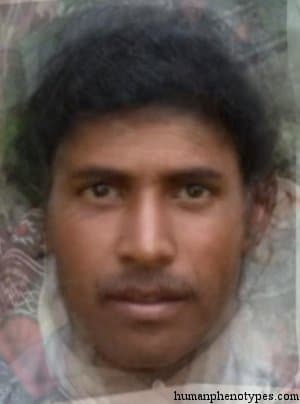
Composite source: Human Phenotypes — Toda
Geographic Distribution
Toda is documented across South Asia, with its historical reference center near 11.4° N, 76.7° E. The coordinates mark where the type was most characteristic roughly 1500 years ago; population movements since then have scattered and blended the distribution far beyond that point.
Physical Characteristics
Medium brown skin, usually wavy black hair.
- (Rather) tall, mesoskelic, ectomorph
- Dolichocephalic, ortho- hypsicranic
- Mildly leptorrhine, long, often convex nose
- Face high and narrow, lips relatively thick compared to other Indids
- Beard and body hair growth is heavy
- The chin relatively weak
Historical Background
Indid subtype, native to the Nilgiri Hills of Southern India. Shows morphological affinities with North Indids and has sometimes been included. Differs from most neighbouring populations and could present an isolate caused by ancient Indo-European migrations. Mostly found in Toda people. Although their numbers have hardly surpassed 1000 during the last century, population is relatively stable.
Research History & Naming
Typological names were coined, contested, and renamed repeatedly across the 20th century, and Toda is no exception. The extract below records the researchers who defined Toda, the alternative labels it accumulated, and where the modern consensus settled.
Eickstedt ( 1929 , 1934 ) described the type in high detail, he regarded it as a typical North Indid. Later ( Eickstedt, 1937 ) he split it off as the southern North Indid subvariety "Toda". Not all included it in North Indid, but it was often regarded as a special local type differing from its neighbours ( Lundman, 1967 ; Vallois, 1971 ) .
Comparison With Nearby Phenotypes
Geography, not alphabet, ordered this table: the five phenotype centers closest to Toda's, with the traits most likely to be mistaken for it (Keralid leads at 120 km). In gameplay, these five account for most of the wrong-but-nearby pins against Toda.
| Phenotype | Region | Distance | Distinguishing trait |
|---|---|---|---|
| Keralid | South Asia | 120 km | Medium brown skin, strait or wavy hair. |
| Malid | South Asia | 144 km | Brown-blackish skin, curly, sometimes wavy hair. |
| Malabarese | South Asia | 168 km | Dark brown skin, black, often wavy hair. |
| Karnatid | South Asia | 208 km | Dark brown skin, darker than Veddids, except for Malids. |
| Sinhalesid | South Asia | 629 km | Brown skin that variety from light to very dark brown, straight or wavy hair. |
Toda in the Game
In gameplay terms, Toda rewards region-level recall: the score is computed from the distance between your pin and 11.4° N, 76.7° E. Players often confuse Toda with Keralid (120 km out) in the comparison table above — those confusions are exactly what the distance penalty is designed to expose.
Toda Phenotype FAQ
- Where does the Toda phenotype come from?
- The reference coordinates for the Toda phenotype sit near 11.4° N, 76.7° E, in South Asia. That point marks the center of the South Asia distribution documented roughly 1500 years ago — actual prevalence spread well beyond it, toward entries such as Keralid 120 km away, and modern migration has blurred those boundaries further.
- What does the Toda phenotype look like?
- In the historical literature, medium brown skin, usually wavy black hair. For Toda these are statistical tendencies across a population, not a checklist every individual matches.
- Is the Toda phenotype a race or a nationality?
- No — and the Toda naming history above shows why. Toda was defined, renamed, and regrouped repeatedly by different researchers, which is the opposite of how a fixed racial category would behave. A phenotype is a recurring bundle of visible traits recorded across a population; the Toda label says nothing about where any individual's ancestors were born.
- How does Toda appear in the game?
- In Classic Daily and Challenge Mode, the Toda composite face appears without a label. Your task is to drop a pin on the world map where you think that face is historically most common — the scoring uses the distance between your pin and the reference coordinates near 11.4° N, 76.7° E. The post-round review then shows the correct location, your distance error, and this Toda entry.
References & Literature
Every claim on this page traces back to the sources below — the researchers who defined, measured, and argued over the Toda type. The originals behind the Toda entry are worth consulting directly.
- Eickstedt, E. von. 1929. Anthropologische Forschungen in Südindien . In: Anthropologischer Anzeiger (6), 64-85.
- Eickstedt, E. von. 1934. Rassenkunde und Rassengeschichte der Menschheit. Ferdinand Enke. Stuttgart.
- Eickstedt, E. von. 1937. Geschichte der anthropologischen Namengebung und Klassifikation. In: Zeitschrift für Rassenkunde. Band 5, 209-282, Band 6, 36-96, 151-210.
- Lundman, B. 1967. Geographische Anthropologie. Rassen und Völker der Erde. G. Fischer, Stuttgart
- Vallois, H. V. 1971. Las races humaines. 8 Ed. Grammont.
Related Phenotypes
Other human phenotypes whose documented centers lie in the same part of the map as Toda.
Keralid
South Asia · 120 km away
Indid subtype, with a position intermediate between North Indid and Gracile Indid, mainly found in the plains of Malabar. Typical for Tiyer ...
Malid
South Asia · 144 km away
Very ancient phenotype native to the mountains of South India, common in isolated groups of Kanikkaran, Kadar, and Paniya. Mixed with Melani...
Malabarese
South Asia · 168 km away
Indid-Veddid influenced type of Southwestern India, found in its most typical form in Kerala, e.g. in Malabarese and related people. Common ...
Karnatid
South Asia · 208 km away
South Indian type, found in its purest form in Tamil Nadu and Northern Sri Lanka, called Melanid according to its dark skin tone (melanin). ...
Sinhalesid
South Asia · 629 km away
Indid subtype, similar to Gracile Indid, mainly found in South-West and Central Sri Lanka. Typical for Sinhalese and related people. This ty...
Further Reading
Background articles from the blog that explain where the Toda type fits, how these composites are built, and what a face can and cannot tell you.
Guess My Ethnicity: What One Guess Can Carry
When someone types guess my ethnicity, they are asking a stranger to place a bet, and the odds depend far more on the list of labels...
Geography Games Like GeoGuessr: Six Kinds of Clue
Street panoramas, country outlines and average faces all answer one question. Here are six geography games sorted by the clue they hand...