Vedda Phenotype - Face Features & Origin
Veddid proper type, typified by aboriginals of Sri Lanka - the Vedda people. The entry below collects the Vedda composite face, its documented distribution around 7.3° N, 81.0° E in South Asia, its physical characteristics, the research history behind the name, and the academic references that support all of it.
Average Face
The Vedda composite below is not a photograph of a real person. Historical anthropologists aligned multiple individual portraits from the Vedda reference population and averaged them into one image, so recurring structures — skull outline, nose form, lip thickness, brow position — dominate while individual idiosyncrasies cancel out.
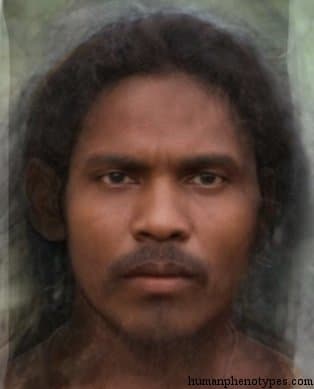
Composite source: Human Phenotypes — Vedda
Geographic Distribution
Vedda is documented across South Asia, with its historical reference center near 7.3° N, 81.0° E. The coordinates mark where the type was most characteristic roughly 1500 years ago; population movements since then have scattered and blended the distribution far beyond that point.
Physical Characteristics
Dark brown skin, but on average lighter than in the Tamil cohabitants.
- Wavy hair, short, hyperbrachyskelic, ectomorph
- Dolichocephalic, mildly hypsicranic, small-headed
- Mesorrhine and low nose
- Round occiput
- Face and body infantile
- The face is relatively low and roundish, zygomatic arches protruding, the chin often receding, forehead steep, eyes are wide and often sunken
- Prognathy mild
Historical Background
Veddid proper type, typified by aboriginals of Sri Lanka - the Vedda people. Relatively ancient with a long history in the region. Relict groups today mostly live in the eastern parts of the island, a few hundred unmixed remain. The Vedda culture and phenotype might vanish soon, although admixture with the type seems relatively common in different parts of the island.
Research History & Naming
Every label in the historical catalogue has an author and a date, and Vedda has accumulated its share of competing attributions. For Vedda, the literature extract below shows the naming chain — from the first definition through the later revisions that shaped the current entry.
Described much earlier than other Veddoid varieties (e.g. Virchow, 1881 and Sarasin, 1893 ). Following Sarasin, Eickstedt ( 1927 , 1934 , 1952b ) defined it as Veddid proper. Cole (1965) , Lundman (1967) , Biasutti (1967) , Knussmann (1996) and many others kept the type.
Comparison With Nearby Phenotypes
The five phenotypes whose documented centers lie closest to Vedda, ranked by great-circle distance. They are the types players most often confuse with Vedda in the quiz, precisely because their distributions overlap.
| Phenotype | Region | Distance | Distinguishing trait |
|---|---|---|---|
| Sinhalesid | South Asia | 40 km | Brown skin that variety from light to very dark brown, straight or wavy hair. |
| Karnatid | South Asia | 515 km | Dark brown skin, darker than Veddids, except for Malids. |
| Malid | South Asia | 535 km | Brown-blackish skin, curly, sometimes wavy hair. |
| Malabarese | South Asia | 593 km | Dark brown skin, black, often wavy hair. |
| Keralid | South Asia | 596 km | Medium brown skin, strait or wavy hair. |
Vedda in the Game
Vedda is one of the faces that can appear in Classic Daily and Challenge Mode. When it does, the winning pin lands near 7.3° N, 81.0° E in South Asia — and because the scoring decays with distance, recognizing the region matters more than pixel-perfect placement.
Vedda Phenotype FAQ
- Where does the Vedda phenotype come from?
- The reference coordinates for the Vedda phenotype sit near 7.3° N, 81.0° E, in South Asia. That point marks the center of the South Asia distribution documented roughly 1500 years ago — actual prevalence spread well beyond it, toward entries such as Sinhalesid 40 km away, and modern migration has blurred those boundaries further.
- What does the Vedda phenotype look like?
- In the historical literature, dark brown skin, but on average lighter than in the Tamil cohabitants. For Vedda these are statistical tendencies across a population, not a checklist every individual matches.
- Is the Vedda phenotype a race or a nationality?
- No. Phenotypes like Vedda are descriptive averages, not ancestry groups. Vedda is one of several types documented in and around South Asia — see the comparison table above — and the same individual can carry traits associated with several of them at once. The Vedda entry describes a statistical pattern, not a group of people and not a nationality.
- How does Vedda appear in the game?
- In Classic Daily and Challenge Mode, the Vedda composite face appears without a label. Your task is to drop a pin on the world map where you think that face is historically most common — the scoring uses the distance between your pin and the reference coordinates near 7.3° N, 81.0° E. The post-round review then shows the correct location, your distance error, and this Vedda entry.
References & Literature
Primary sources for the Vedda entry, listed as cited in the historical literature. The naming and classification debates around Vedda referenced above run through these works.
- Virchow, R.. 1881. Die Weddas von Ceylon und ihre Beziehungen zu den Nachbarstämmen. Abh. Kgl. Akad. Wissen, Berlin. 1-143.
- Sarasin, F. 1893. Ergebnisse naturwissenschaftlicher forschungen auf Ceylon. Die Weddas von Ceylon und ihre Beziehungen zu den Nachbarschaften. Atlas. C.W. Kreidel's Verlag. Wiesbaden.
- Eickstedt, E. von. 1927. Die Indien-Expedition des Staatlichen Forschungsinstituts für Völkerkunde in Leipzig. In: Anthropologischer Anzeiger (4), 208-219.
- Eickstedt, E. von. 1934. Rassenkunde und Rassengeschichte der Menschheit. Ferdinand Enke. Stuttgart.
- Eickstedt, E. von. 1952b. Die prioritätsgerechten Bezeichnungen der menschlichen Varitäten. In: Historia Mundi. Band 1, Munich, 223-226.
- Cole, S. 1965. Races of Man. Butler & Tanner Ltd. Frome and London.
- Lundman, B. 1967. Geographische Anthropologie. Rassen und Völker der Erde. G. Fischer, Stuttgart
- Biasutti, R. 1967 (1941). Le Razze e i Popoli della terra. 4th Ed. Vol 1-4. U.T.E.T., Torino.
- Knussmann, R. 1996. Vergleichende Biologie des Menschen: Lehrbuch der Anthropologie und Humangenetik. 2ed. Spektrum Akademischer Verlag.
Related Phenotypes
Other human phenotypes whose documented centers lie in the same part of the map as Vedda.
Sinhalesid
South Asia · 40 km away
Indid subtype, similar to Gracile Indid, mainly found in South-West and Central Sri Lanka. Typical for Sinhalese and related people. This ty...
Karnatid
South Asia · 515 km away
South Indian type, found in its purest form in Tamil Nadu and Northern Sri Lanka, called Melanid according to its dark skin tone (melanin). ...
Malid
South Asia · 535 km away
Very ancient phenotype native to the mountains of South India, common in isolated groups of Kanikkaran, Kadar, and Paniya. Mixed with Melani...
Malabarese
South Asia · 593 km away
Indid-Veddid influenced type of Southwestern India, found in its most typical form in Kerala, e.g. in Malabarese and related people. Common ...
Keralid
South Asia · 596 km away
Indid subtype, with a position intermediate between North Indid and Gracile Indid, mainly found in the plains of Malabar. Typical for Tiyer ...
Further Reading
Background articles from the blog that explain where the Vedda type fits, how these composites are built, and what a face can and cannot tell you.
Geography Games Like GeoGuessr: Six Kinds of Clue
Street panoramas, country outlines and average faces all answer one question. Here are six geography games sorted by the clue they hand...
AI Ethnicity Analyzer: Four Instruments, One Name
An analyzer implies parts, but four quite different machines trade under that name: a label classifier, a geometry tool, an embedding...