Arizonid Phenotype - Face Features & Origin
Historical anthropology places the Arizonid phenotype in North America, with a documented center near 34.4° N, 111.8° W. Relatively recent North American contact type. The sections that follow unpack the Arizonid entry in practice: the composite face, the traits it summarizes, the naming history, and the sources.
Average Face
Averaging the portraits behind Arizonid leaves the features that repeat and erases the ones that do not. That is exactly how the Arizonid composite below was built: individual photographs were aligned and statistically merged, exaggerating shared structure into a single reference face that no actual person looks like.
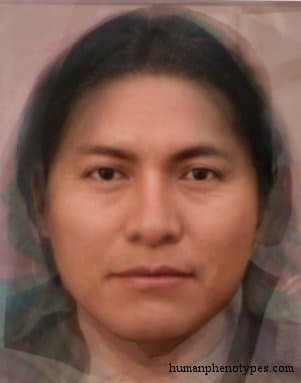
Composite source: Human Phenotypes — Arizonid
Geographic Distribution
Arizonid is documented across North America, with its historical reference center near 34.4° N, 111.8° W. The coordinates mark where the type was most characteristic roughly 1500 years ago; population movements since then have scattered and blended the distribution far beyond that point.
Physical Characteristics
Light yellowish/reddish-brown skin with straight or wavy, dark brown or black hair.
- (Rather) tall, meso- macroskelic with an endomorph to mesomorph, very robust body
- Brachycephalic, orthocranic
- Mildly leptorrhine, prominent, straight or slightly convex nose
- The face is wide, hair growth moderate
- Eyes mildly slanted
Historical Background
Relatively recent North American contact type. Started to develop as Athabaskan speakers of Canada migrated South during late Pre-Columbian periods, and became more numerous when Europeans reintroduced the horse to America, which facilitated bison hunts in the prairie. Today typical in Apache, Navajo, and Comanche, also in some neighbouring tribes. Still relatively numerous.
Research History & Naming
Every label in the historical catalogue has an author and a date, and Arizonid has accumulated its share of competing attributions. For Arizonid, the literature extract below shows the naming chain — from the first definition through the later revisions that shaped the current entry.
Named and defined by Lundman ( 1943 , 1952 , 1967 ) as a contact type, he included some Pueblid groups. Eickstedt (1934) called it South Pacifid, noting Silvid and Centralid admixture. Canals Frau (1950) regarded it as Pacifid. Imbelloni (1958) and Biasutti (1967) described it as an admixed Pueblo-Andid.
Comparison With Nearby Phenotypes
Geography, not alphabet, ordered this table: the five phenotype centers closest to Arizonid's, with the traits most likely to be mistaken for it (Pueblid leads at 529 km). In gameplay, these five account for most of the wrong-but-nearby pins against Arizonid.
| Phenotype | Region | Distance | Distinguishing trait |
|---|---|---|---|
| Pueblid | North America | 529 km | Light to medium brown skin with straight or wavy hair. |
| Sonorid | North America | 572 km | Yellowish-reddish medium to dark brown skin, straight or wavy black hair. |
| Californid | North America | 682 km | Medium brown skin with straight hair. |
| Planid | North America | 1,085 km | Yellowish/reddish light brown skin, but the name "red skin" came from war paint. |
| California Pacifid | North America | 1,162 km | Light, sometimes medium yellowish-brown skin with straight or wavy, dark brown hair. |
Arizonid in the Game
In gameplay terms, Arizonid rewards region-level recall: the score is computed from the distance between your pin and 34.4° N, 111.8° W. Players often confuse Arizonid with Pueblid (529 km out) in the comparison table above — those confusions are exactly what the distance penalty is designed to expose.
Arizonid Phenotype FAQ
- Where does the Arizonid phenotype come from?
- The reference coordinates for the Arizonid phenotype sit near 34.4° N, 111.8° W, in North America. That point marks the center of the North America distribution documented roughly 1500 years ago — actual prevalence spread well beyond it, toward entries such as Pueblid 529 km away, and modern migration has blurred those boundaries further.
- What does the Arizonid phenotype look like?
- In the historical literature, light yellowish/reddish-brown skin with straight or wavy, dark brown or black hair. For Arizonid these are statistical tendencies across a population, not a checklist every individual matches.
- Is the Arizonid phenotype a race or a nationality?
- No — and the Arizonid naming history above shows why. Arizonid was defined, renamed, and regrouped repeatedly by different researchers, which is the opposite of how a fixed racial category would behave. A phenotype is a recurring bundle of visible traits recorded across a population; the Arizonid label says nothing about where any individual's ancestors were born.
- How does Arizonid appear in the game?
- In Classic Daily and Challenge Mode, the Arizonid composite face appears without a label. Your task is to drop a pin on the world map where you think that face is historically most common — the scoring uses the distance between your pin and the reference coordinates near 34.4° N, 111.8° W. The post-round review then shows the correct location, your distance error, and this Arizonid entry.
References & Literature
Primary sources for the Arizonid entry, listed as cited in the historical literature. The naming and classification debates around Arizonid referenced above run through these works.
- Lundman, B. 1943. Jordens Människoraser och Folkstammar. Nybloms Förlag, Uppsala.
- Lundman, B. 1952. Umriss der Rassenkunde des Menschen in geschichtlicher Zeit. Ejnar Munksgaard. Kopenhagen.
- Lundman, B. 1967. Geographische Anthropologie. Rassen und Völker der Erde. G. Fischer, Stuttgart
- Eickstedt, E. von. 1934. Rassenkunde und Rassengeschichte der Menschheit. Ferdinand Enke. Stuttgart.
- Coon, C. S., Garn, S. M. and Birdsell, J. B. 1950. Races: a Study of Race formation in Man. Charles C. Thomas. Springfield.
- Imbelloni, J. 1958. Nouveaux apports à la classification de l'homme américain. Miscellanea P. Rivet octogenario dicata. Mexico.
- Biasutti, R. 1967 (1941). Le Razze e i Popoli della terra. 4th Ed. Vol 1-4. U.T.E.T., Torino.
Related Phenotypes
Other human phenotypes whose documented centers lie in the same part of the map as Arizonid.
Pueblid
North America · 529 km away
Native American type, named after the Pueblo communities in Southwestern North America. Extends over a large area of Southern US states as w...
Sonorid
North America · 572 km away
Margid subtype, native to the hot Sonora desert of South Arizona and California, as well as Northwestern Mexico. Probably arrived with one o...
Californid
North America · 682 km away
Ancient Margid subtype, probably arrived with one of the oldest migrations to America. Shares some features with Ainuids. During the last ce...
Planid
North America · 1,085 km away
Native American type, named after the Great Plains of North America. In pre-Colombian times concentrated in the Central Canadian forests fro...
California Pacifid
North America · 1,162 km away
Pacifid variety of California and South Washington. In its purest form in Northern California. Typified by the Yurok as well as Chinook grou...
Further Reading
Background articles from the blog that explain where the Arizonid type fits, how these composites are built, and what a face can and cannot tell you.
Geography Games Like GeoGuessr: Six Kinds of Clue
Street panoramas, country outlines and average faces all answer one question. Here are six geography games sorted by the clue they hand...
Ethnicity Do I Look: A Question About Observers
The phrase is a fragment of a longer question, and its verb points at an observer, not at you. Perception research shows what observers...