Sonorid Phenotype - Face Features & Origin
Margid subtype, native to the hot Sonora desert of South Arizona and California, as well as Northwestern Mexico. The entry below collects the Sonorid composite face, its documented distribution around 29.3° N, 110.7° W in North America, its physical characteristics, the research history behind the name, and the academic references that support all of it.
Average Face
The Sonorid composite below is not a photograph of a real person. Historical anthropologists aligned multiple individual portraits from the Sonorid reference population and averaged them into one image, so recurring structures — skull outline, nose form, lip thickness, brow position — dominate while individual idiosyncrasies cancel out.
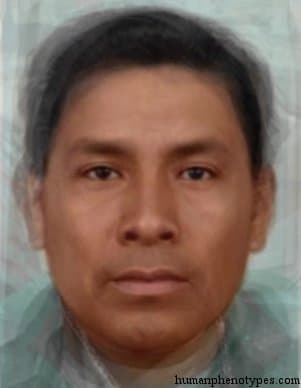
Composite source: Human Phenotypes — Sonorid
Geographic Distribution
Sonorid is documented across North America, with its historical reference center near 29.3° N, 110.7° W. The coordinates mark where the type was most characteristic roughly 1500 years ago; population movements since then have scattered and blended the distribution far beyond that point.
Physical Characteristics
Yellowish-reddish medium to dark brown skin, straight or wavy black hair.
- (Rather) tall, meso- sometimes macroskelic, ectomorph, sometimes endomorph
- Mesocephalic, mildly hypsicranic
- Mesorrhine, straight or slightly convex nose
- Lower face is pointed oval
- More gracile and elongated compared to other Margids
- Eyes usually not slanted
Historical Background
Margid subtype, native to the hot Sonora desert of South Arizona and California, as well as Northwestern Mexico. Probably arrived with one of the earlier migrations to America. Today typified by the Pima (O'odham) and the Seri. More mixed in Yuma, Papago, Tlapaneco, and many other people of the Southern US and Mexico. Probably played an important role in the extinct inhabitants of Baja California.
Research History & Naming
Every label in the historical catalogue has an author and a date, and Sonorid has accumulated its share of competing attributions. For Sonorid, the literature extract below shows the naming chain — from the first definition through the later revisions that shaped the current entry.
First described as the Sonoran type by Boas (1895) and Hrdlicka (1906) . Eickstedt (1934) regarded it a Margid subtype, Knussmann (1996) entirely included it. Imbelloni (1952) and Biasutti (1967) entirely replaced Margid by Sonorid, including the shorter varieties. Detailed descriptions by McGee (1898) and Genna (1943) .
Comparison With Nearby Phenotypes
Ranked by great-circle distance from Sonorid's reference center, these are the five nearest documented phenotypes — the closest being Arizonid at 572 km. Overlapping distributions like these are exactly what makes the quiz hard, and the Arizonid row is where to start looking.
| Phenotype | Region | Distance | Distinguishing trait |
|---|---|---|---|
| Arizonid | North America | 572 km | Light yellowish/reddish-brown skin with straight or wavy, dark brown or black hair. |
| Pueblid | North America | 731 km | Light to medium brown skin with straight or wavy hair. |
| Mexicid | North America | 1,094 km | Reddish medium, sometimes dark brown skin, often straight black hair. |
| Californid | North America | 1,113 km | Medium brown skin with straight hair. |
| Planid | North America | 1,411 km | Yellowish/reddish light brown skin, but the name "red skin" came from war paint. |
Sonorid in the Game
When the Sonorid composite shows up in the quiz, players who know the North America distribution pattern have the edge. The reference answer sits near 29.3° N, 110.7° W; pins on the wrong continent score close to zero, so even a rough regional instinct beats a precise but misdirected pin.
Sonorid Phenotype FAQ
- Where does the Sonorid phenotype come from?
- The reference coordinates for the Sonorid phenotype sit near 29.3° N, 110.7° W, in North America. That point marks the center of the North America distribution documented roughly 1500 years ago — actual prevalence spread well beyond it, toward entries such as Arizonid 572 km away, and modern migration has blurred those boundaries further.
- What does the Sonorid phenotype look like?
- In the historical literature, yellowish-reddish medium to dark brown skin, straight or wavy black hair. For Sonorid these are statistical tendencies across a population, not a checklist every individual matches.
- Is the Sonorid phenotype a race or a nationality?
- No. A phenotype is a recurring bundle of visible traits documented by historical anthropologists across a population — for Sonorid, patterns such as yellowish-reddish medium to dark brown skin, straight or wavy black hair. The Sonorid entry is not a genetic ancestry, not a nationality, and not a statement about any individual person. Two people from the same country can match completely different phenotypes — one resembling Sonorid, another closer to Arizonid — and one phenotype can span many modern borders.
- How does Sonorid appear in the game?
- In Classic Daily and Challenge Mode, the Sonorid composite face appears without a label. Your task is to drop a pin on the world map where you think that face is historically most common — the scoring uses the distance between your pin and the reference coordinates near 29.3° N, 110.7° W. The post-round review then shows the correct location, your distance error, and this Sonorid entry.
References & Literature
Primary sources for the Sonorid entry, listed as cited in the historical literature. The naming and classification debates around Sonorid referenced above run through these works.
- Boas, F. 1895. Zur Anthropologie der nordamerikanischen Indianer. Zeitschrift für Ethnol. 27, Verh. 366-401.
- Hrdlicka, A. 1906. Contribution to the Physical Anthropology of California. Univ. Californ. Publ. Am. Arch. Ethn. 4. 49-64.
- Eickstedt, E. von. 1934. Rassenkunde und Rassengeschichte der Menschheit. Ferdinand Enke. Stuttgart.
- Knussmann, R. 1996. Vergleichende Biologie des Menschen: Lehrbuch der Anthropologie und Humangenetik. 2ed. Spektrum Akademischer Verlag.
- Imbelloni, J. 1952. Rassentypen und Biodynamik von Amerika. In: Historia Mundi. Band 1, Munich, 188-203.
- Biasutti, R. 1967 (1941). Le Razze e i Popoli della terra. 4th Ed. Vol 1-4. U.T.E.T., Torino.
- McGee, W. G. 1898. The Seri Indians. 7. Ann. Rep. Bureau Am. Ethn. (1895-1896), 9-344.
- Genna, G. 1943. I Seri e la loro costituzione scheletrica. C.I.S.P., Ser. V, Sped. scient. dirette da C. Gini, I. Florence.
Related Phenotypes
If Sonorid interested you, these neighboring phenotype entries cover adjacent parts of the map with distinctly different trait bundles.
Arizonid
North America · 572 km away
Relatively recent North American contact type. Started to develop as Athabaskan speakers of Canada migrated South during late Pre-Columbian ...
Pueblid
North America · 731 km away
Native American type, named after the Pueblo communities in Southwestern North America. Extends over a large area of Southern US states as w...
Mexicid
North America · 1,094 km away
Margid proper. Probably arrived with one of the earlier migrations to America. Typified by Otomi, Purépecha, Pame, Pima of Mexico, as well W...
Californid
North America · 1,113 km away
Ancient Margid subtype, probably arrived with one of the oldest migrations to America. Shares some features with Ainuids. During the last ce...
Planid
North America · 1,411 km away
Native American type, named after the Great Plains of North America. In pre-Colombian times concentrated in the Central Canadian forests fro...
Further Reading
Background articles from the blog that explain where the Sonorid type fits, how these composites are built, and what a face can and cannot tell you.
Ethnicity Do I Look: A Question About Observers
The phrase is a fragment of a longer question, and its verb points at an observer, not at you. Perception research shows what observers...
Geography Games Like GeoGuessr: Six Kinds of Clue
Street panoramas, country outlines and average faces all answer one question. Here are six geography games sorted by the clue they hand...