Mexicid Phenotype - Face Features & Origin
Margid proper. Its reference coordinates sit near 25.7° N, 100.3° W in North America. Rather than a single portrait, the Mexicid composite below is a statistical average, and the surrounding sections — traits, distribution, research history, references — give that average its context.
Average Face
What you see below is a statistical construction of the Mexicid reference population. Faces recorded from the Mexicid sample were overlaid and merged; the result keeps the features most members shared and discards personal variation. It reads like a Mexicid portrait, but it works like a histogram.
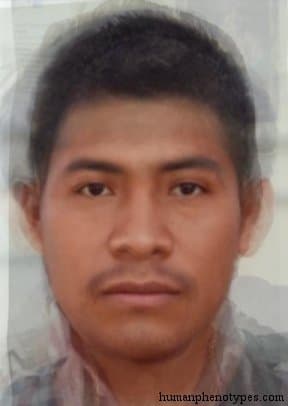
Composite source: Human Phenotypes — Mexicid
Geographic Distribution
The reference center for Mexicid sits near 25.7° N, 100.3° W in North America. Around that anchor, prevalence falls off gradually — the type is not confined to one valley or one modern border, and the historical map should be read as a gradient rather than a boundary.
Physical Characteristics
Reddish medium, sometimes dark brown skin, often straight black hair.
- (Rather) short, meso-, sometimes macroskelic, endomorph, sometimes ectomorph
- Mesocephalic, sometimes dolichocephalic, mildly hypsicranic
- Mesorrhine, straight or slightly concave nose with a depressed root
- Face rhomboid, mildly prognathous
- Chin slightly receding, visible supraorbital arches
- Eyes usually not slanted
Historical Background
Margid proper. Probably arrived with one of the earlier migrations to America. Typified by Otomi, Purépecha, Pame, Pima of Mexico, as well West Mono and Pomo of California. More mixed in Maidu, Aztecs, Maya, Yuma, Shoshone, and many others over a large area from Northern Guatemala to the Great Plains. Although it is often mixed today, it still plays an important role in modern Mexicans.
Research History & Naming
Every label in the historical catalogue has an author and a date, and Mexicid has accumulated its share of competing attributions. For Mexicid, the literature extract below shows the naming chain — from the first definition through the later revisions that shaped the current entry.
Named and defined by Lundman (1967) , who separated it from Californids who were often combined with the type by other authors, they generally regarded it the Margid proper ( Eickstedt, 1934 ; Vogel, 1974 ; Knussmann, 1996 ). Imbelloni (1952) and Biasutti (1967) regarded it a shorter, robust version of Sonorid.
Comparison With Nearby Phenotypes
Geography, not alphabet, ordered this table: the five phenotype centers closest to Mexicid's, with the traits most likely to be mistaken for it (Sonorid leads at 1,094 km). In gameplay, these five account for most of the wrong-but-nearby pins against Mexicid.
| Phenotype | Region | Distance | Distinguishing trait |
|---|---|---|---|
| Sonorid | North America | 1,094 km | Yellowish-reddish medium to dark brown skin, straight or wavy black hair. |
| Pueblid | North America | 1,125 km | Light to medium brown skin with straight or wavy hair. |
| Maya | North America | 1,334 km | Medium, sometimes light brown skin with straight or wavy hair. |
| Arizonid | North America | 1,461 km | Light yellowish/reddish-brown skin with straight or wavy, dark brown or black hair. |
| Planid | North America | 1,526 km | Yellowish/reddish light brown skin, but the name "red skin" came from war paint. |
Mexicid in the Game
In gameplay terms, Mexicid rewards region-level recall: the score is computed from the distance between your pin and 25.7° N, 100.3° W. Players often confuse Mexicid with Sonorid (1,094 km out) in the comparison table above — those confusions are exactly what the distance penalty is designed to expose.
Mexicid Phenotype FAQ
- Where does the Mexicid phenotype come from?
- Historical sources center the Mexicid phenotype on 25.7° N, 100.3° W (North America). Treat that as a rough anchor: the type appeared across a wider surrounding area — its nearest documented neighbors, Sonorid and Pueblid, sit 1,094 and 1,125 km from the reference point — and its present-day distribution no longer matches the historical map.
- What does the Mexicid phenotype look like?
- The composite emphasizes recurring traits: reddish medium, sometimes dark brown skin, often straight black hair. The full trait list for Mexicid appears in the physical characteristics section above.
- Is the Mexicid phenotype a race or a nationality?
- No. A phenotype is a recurring bundle of visible traits documented by historical anthropologists across a population — for Mexicid, patterns such as reddish medium, sometimes dark brown skin, often straight black hair. The Mexicid entry is not a genetic ancestry, not a nationality, and not a statement about any individual person. Two people from the same country can match completely different phenotypes — one resembling Mexicid, another closer to Sonorid — and one phenotype can span many modern borders.
- How does Mexicid appear in the game?
- When the Mexicid face comes up in Classic Daily or Challenge Mode, you pin the world map where you believe the type is historically most common, and the score decays with your distance to 25.7° N, 100.3° W. The nearest documented type, Sonorid, lies about 1,094 km away, so regional placement usually carries most of the score.
References & Literature
Primary sources for the Mexicid entry, listed as cited in the historical literature. The naming and classification debates around Mexicid referenced above run through these works.
- Lundman, B. 1967. Geographische Anthropologie. Rassen und Völker der Erde. G. Fischer, Stuttgart
- Eickstedt, E. von. 1934. Rassenkunde und Rassengeschichte der Menschheit. Ferdinand Enke. Stuttgart.
- Virchow, R. 1874. Die physische Anthropologie der Finnen. Verh. Berliner Ges. Anthr. Ethnol. Urg. VI. 185-189.
- Knussmann, R. 1996. Vergleichende Biologie des Menschen: Lehrbuch der Anthropologie und Humangenetik. 2ed. Spektrum Akademischer Verlag.
- Imbelloni, J. 1952. Rassentypen und Biodynamik von Amerika. In: Historia Mundi. Band 1, Munich, 188-203.
- Biasutti, R. 1967 (1941). Le Razze e i Popoli della terra. 4th Ed. Vol 1-4. U.T.E.T., Torino.
Related Phenotypes
More entries from the same region of the historical map as Mexicid, each with its own composite and trait profile.
Sonorid
North America · 1,094 km away
Margid subtype, native to the hot Sonora desert of South Arizona and California, as well as Northwestern Mexico. Probably arrived with one o...
Pueblid
North America · 1,125 km away
Native American type, named after the Pueblo communities in Southwestern North America. Extends over a large area of Southern US states as w...
Maya
North America · 1,334 km away
Centralid subtype with a position between Pueblid and Isthmid and a variety of unique features. Was the dominant element in the ancient Maya...
Arizonid
North America · 1,461 km away
Relatively recent North American contact type. Started to develop as Athabaskan speakers of Canada migrated South during late Pre-Columbian ...
Planid
North America · 1,526 km away
Native American type, named after the Great Plains of North America. In pre-Colombian times concentrated in the Central Canadian forests fro...
Further Reading
Background articles from the blog that explain where the Mexicid type fits, how these composites are built, and what a face can and cannot tell you.
Ethnicity Do I Look: A Question About Observers
The phrase is a fragment of a longer question, and its verb points at an observer, not at you. Perception research shows what observers...
Geography Games Like GeoGuessr: Six Kinds of Clue
Street panoramas, country outlines and average faces all answer one question. Here are six geography games sorted by the clue they hand...