Pueblid Phenotype - Face Features & Origin
Native American type, named after the Pueblo communities in Southwestern North America. The entry below collects the Pueblid composite face, its documented distribution around 34.6° N, 106.0° W in North America, its physical characteristics, the research history behind the name, and the academic references that support all of it.
Average Face
The Pueblid composite below is not a photograph of a real person. Historical anthropologists aligned multiple individual portraits from the Pueblid reference population and averaged them into one image, so recurring structures — skull outline, nose form, lip thickness, brow position — dominate while individual idiosyncrasies cancel out.
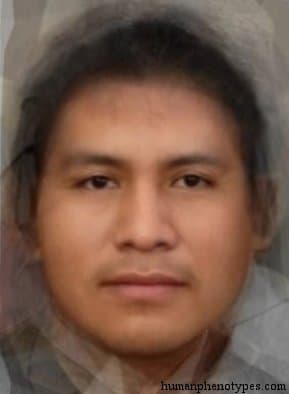
Composite source: Human Phenotypes — Pueblid
Geographic Distribution
Geographically, Pueblid anchors to 34.6° N, 106.0° W (North America). That is the point where historical anthropologists judged Pueblid most concentrated, not a hard edge; modern migration and intermarriage have long since softened whatever boundaries once existed.
Physical Characteristics
Light to medium brown skin with straight or wavy hair.
- Medium height to tall, mesoskelic, endomorph
- (Hyper-)brachycephalic, hypsicranic with a mesorrhine, occasionally convex nose
- Rectangular face with an angular chin that is often receding
- Forehead is narrow, body hair relatively strong, eyes mildly slanting
Historical Background
Native American type, named after the Pueblo communities in Southwestern North America. Extends over a large area of Southern US states as well as Mexico. Most common in Hopi, Zuni, Choctaw, Caddo, Ute, Mohave, Nahua, Huichol, and many of their neighbours. As far North as Ojibwe and Kickapo and as far South as Aztecs, in those groups usually more mixed. Albinism comparatively common.
Research History & Naming
The passage below traces who first defined Pueblid, which rival names competed with it, and how later authors consolidated or disputed the classification — the raw material of any serious phenotype reference.
Named and defined by Eickstedt (1952) , who had called it the "northern, silvoid Centralid belt" earlier ( Eickstedt, 1934 ). Imbelloni (1952) and Biasutti (1967) combine it with Andid to Pueblo-Andid. Detailed descriptions by Hooton (1930) and Seltzer (1944) . Neumann's ( 1952 , 1966 ) Ashiwids and Iswanids are similar.
Comparison With Nearby Phenotypes
The five phenotypes whose documented centers lie closest to Pueblid, ranked by great-circle distance. They are the types players most often confuse with Pueblid in the quiz, precisely because their distributions overlap.
| Phenotype | Region | Distance | Distinguishing trait |
|---|---|---|---|
| Arizonid | North America | 529 km | Light yellowish/reddish-brown skin with straight or wavy, dark brown or black hair. |
| Planid | North America | 681 km | Yellowish/reddish light brown skin, but the name "red skin" came from war paint. |
| Sonorid | North America | 731 km | Yellowish-reddish medium to dark brown skin, straight or wavy black hair. |
| Mexicid | North America | 1,125 km | Reddish medium, sometimes dark brown skin, often straight black hair. |
| Californid | North America | 1,176 km | Medium brown skin with straight hair. |
Pueblid in the Game
Pueblid is one of the faces that can appear in Classic Daily and Challenge Mode. When it does, the winning pin lands near 34.6° N, 106.0° W in North America — and because the scoring decays with distance, recognizing the region matters more than pixel-perfect placement.
Pueblid Phenotype FAQ
- Where does the Pueblid phenotype come from?
- Historical sources center the Pueblid phenotype on 34.6° N, 106.0° W (North America). Treat that as a rough anchor: the type appeared across a wider surrounding area — its nearest documented neighbors, Arizonid and Planid, sit 529 and 681 km from the reference point — and its present-day distribution no longer matches the historical map.
- What does the Pueblid phenotype look like?
- The composite emphasizes recurring traits: light to medium brown skin with straight or wavy hair. The full trait list for Pueblid appears in the physical characteristics section above.
- Is the Pueblid phenotype a race or a nationality?
- No — and the Pueblid naming history above shows why. Pueblid was defined, renamed, and regrouped repeatedly by different researchers, which is the opposite of how a fixed racial category would behave. A phenotype is a recurring bundle of visible traits recorded across a population; the Pueblid label says nothing about where any individual's ancestors were born.
- How does Pueblid appear in the game?
- When the Pueblid face comes up in Classic Daily or Challenge Mode, you pin the world map where you believe the type is historically most common, and the score decays with your distance to 34.6° N, 106.0° W. The nearest documented type, Arizonid, lies about 529 km away, so regional placement usually carries most of the score.
References & Literature
The Pueblid phenotype entry above is compiled from the 8 academic references. Readers are encouraged to consult the original Pueblid sources for verification and deeper context.
- Eickstedt, E. von. 1952. Biodynamik der Europiden. In: Historia Mundi. Band 1, Munich, 115-134.
- Eickstedt, E. von. 1934. Rassenkunde und Rassengeschichte der Menschheit. Ferdinand Enke. Stuttgart.
- Imbelloni, J. 1952. Rassentypen und Biodynamik von Amerika. In: Historia Mundi. Band 1, Munich, 188-203.
- Biasutti, R. 1967 (1941). Le Razze e i Popoli della terra. 4th Ed. Vol 1-4. U.T.E.T., Torino.
- Hooton, E. 1930. The lndians of Pecos Pueblo, New Haven.
- Seltzer, C. C. 1944. Racial prehistory in the Southwest and the Hawikuh Zunis. PMP, 23, 1.
- Neumann, G.. 1952. Archeology and Race in the American Indian.13-34. In: Griffin, J. Archeology of Eastern United States. Chicago and London.
- Neumann, G.. 1966. Racial History of the Indians. 505-518. In: Lindsey, A. Natural Features of Indiana. Indiana Sesquicentennial Vol., Indiana A. of Sci.
Related Phenotypes
Other human phenotypes whose documented centers lie in the same part of the map as Pueblid.
Arizonid
North America · 529 km away
Relatively recent North American contact type. Started to develop as Athabaskan speakers of Canada migrated South during late Pre-Columbian ...
Planid
North America · 681 km away
Native American type, named after the Great Plains of North America. In pre-Colombian times concentrated in the Central Canadian forests fro...
Sonorid
North America · 731 km away
Margid subtype, native to the hot Sonora desert of South Arizona and California, as well as Northwestern Mexico. Probably arrived with one o...
Mexicid
North America · 1,125 km away
Margid proper. Probably arrived with one of the earlier migrations to America. Typified by Otomi, Purépecha, Pame, Pima of Mexico, as well W...
Californid
North America · 1,176 km away
Ancient Margid subtype, probably arrived with one of the oldest migrations to America. Shares some features with Ainuids. During the last ce...
Further Reading
Background articles from the blog that explain where the Pueblid type fits, how these composites are built, and what a face can and cannot tell you.
Ethnicity Do I Look: A Question About Observers
The phrase is a fragment of a longer question, and its verb points at an observer, not at you. Perception research shows what observers...
Geography Games Like GeoGuessr: Six Kinds of Clue
Street panoramas, country outlines and average faces all answer one question. Here are six geography games sorted by the clue they hand...