Appalacid Phenotype - Face Features & Origin
Historical anthropology places the Appalacid phenotype in North America, with a documented center near 35.8° N, 82.3° W. Silvid subtype, native to the North American Atlantic forests, from the Great Lakes to the Appalachians. The sections that follow unpack the Appalacid entry in practice: the composite face, the traits it summarizes, the naming history, and the sources.
Average Face
Averaging the portraits behind Appalacid leaves the features that repeat and erases the ones that do not. That is exactly how the Appalacid composite below was built: individual photographs were aligned and statistically merged, exaggerating shared structure into a single reference face that no actual person looks like.
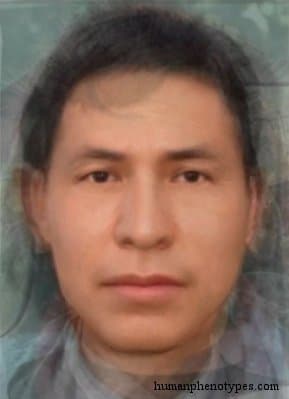
Composite source: Human Phenotypes — Appalacid
Geographic Distribution
Appalacid is documented across North America, with its historical reference center near 35.8° N, 82.3° W. The coordinates mark where the type was most characteristic roughly 1500 years ago; population movements since then have scattered and blended the distribution far beyond that point.
Physical Characteristics
Light yellowish-brown skin, the name "red skin" came from war colouring.
- Straight or wavy black hair
- Tall, mesoskelic, ectomorph to mesomorph
- Dolicho- mesocephalic, mildly hypsicranic
- Mildly leptorrhine, sometimes convex nose
- Face oval, supraorbital arches marked, forehead sloping
- Cheekbones weaker and face higher than in Planid
Historical Background
Silvid subtype, native to the North American Atlantic forests, from the Great Lakes to the Appalachians. Shows some Europid traits, not only phenotypically, but also genetically. This could be due to early colonial admixture, or Proto Europid migrations across the Atlantic (Solutrean hypothesis) or the Bering Strait, the latter being the most likely. Common in East Algonquins and Iroquois, more mixed in Mi'kmaq, Cherokee, Cree, and others. Rare today in pure form.
Research History & Naming
Typological names were coined, contested, and renamed repeatedly across the 20th century, and Appalacid is no exception. The extract below records the researchers who defined Appalacid, the alternative labels it accumulated, and where the modern consensus settled.
First identified by Hrdlicka (1927) and named Alkonkinid by Eickstedt (1934) who regarded it a Silvid subtype. Imbelloni (1952) and Cerulli (1967) defined it as Appalacid, including some of Eickstedt's Margids, Biasutti (1967) named it Alleganica subrace, Neumann ( 1952 , 1966 ) Lenapid.
Comparison With Nearby Phenotypes
The five phenotypes whose documented centers lie closest to Appalacid, ranked by great-circle distance. They are the types players most often confuse with Appalacid in the quiz, precisely because their distributions overlap.
| Phenotype | Region | Distance | Distinguishing trait |
|---|---|---|---|
| Planid | North America | 1,723 km | Yellowish/reddish light brown skin, but the name "red skin" came from war paint. |
| Maya | North America | 2,023 km | Medium, sometimes light brown skin with straight or wavy hair. |
| Mexicid | North America | 2,053 km | Reddish medium, sometimes dark brown skin, often straight black hair. |
| Pueblid | North America | 2,157 km | Light to medium brown skin with straight or wavy hair. |
| Arizonid | North America | 2,680 km | Light yellowish/reddish-brown skin with straight or wavy, dark brown or black hair. |
Appalacid in the Game
Appalacid is one of the faces that can appear in Classic Daily and Challenge Mode. When it does, the winning pin lands near 35.8° N, 82.3° W in North America — and because the scoring decays with distance, recognizing the region matters more than pixel-perfect placement.
Appalacid Phenotype FAQ
- Where does the Appalacid phenotype come from?
- Historical sources center the Appalacid phenotype on 35.8° N, 82.3° W (North America). Treat that as a rough anchor: the type appeared across a wider surrounding area — its nearest documented neighbors, Planid and Maya, sit 1,723 and 2,023 km from the reference point — and its present-day distribution no longer matches the historical map.
- What does the Appalacid phenotype look like?
- The composite emphasizes recurring traits: light yellowish-brown skin, the name "red skin" came from war colouring. The full trait list for Appalacid appears in the physical characteristics section above.
- Is the Appalacid phenotype a race or a nationality?
- No. Phenotypes like Appalacid are descriptive averages, not ancestry groups. Appalacid is one of several types documented in and around North America — see the comparison table above — and the same individual can carry traits associated with several of them at once. The Appalacid entry describes a statistical pattern, not a group of people and not a nationality.
- How does Appalacid appear in the game?
- When the Appalacid face comes up in Classic Daily or Challenge Mode, you pin the world map where you believe the type is historically most common, and the score decays with your distance to 35.8° N, 82.3° W. The nearest documented type, Planid, lies 1,723 km away — an isolated reference point, so even a broad regional answer scores respectably here.
References & Literature
Every claim on this page traces back to the sources below — the researchers who defined, measured, and argued over the Appalacid type. The originals behind the Appalacid entry are worth consulting directly.
- Hrdlicka, A. The Algokin and related Iroquois, Siouan, Caddoan, Salish and Sahaptin, Shoshonean and Californian Indians. Proc. US. Nat Mus. 69, 5. 1-127.
- Eickstedt, E. von. 1934. Rassenkunde und Rassengeschichte der Menschheit. Ferdinand Enke. Stuttgart.
- Imbelloni, J. 1952. Rassentypen und Biodynamik von Amerika. In: Historia Mundi. Band 1, Munich, 188-203.
- Czekanowski, J.. 1967. Cz owiek w czasie i przestrzenie. Pa stwowe Wydawnictwo Naukowe. Warsaw.
- Biasutti, R. 1967 (1941). Le Razze e i Popoli della terra. 4th Ed. Vol 1-4. U.T.E.T., Torino.
- Neumann, G.. 1952. Archeology and Race in the American Indian.13-34. In: Griffin, J. Archeology of Eastern United States. Chicago and London.
- Neumann, G.. 1966. Racial History of the Indians. 505-518. In: Lindsey, A. Natural Features of Indiana. Indiana Sesquicentennial Vol., Indiana A. of Sci.
Related Phenotypes
More entries from the same region of the historical map as Appalacid, each with its own composite and trait profile.
Planid
North America · 1,723 km away
Native American type, named after the Great Plains of North America. In pre-Colombian times concentrated in the Central Canadian forests fro...
Maya
North America · 2,023 km away
Centralid subtype with a position between Pueblid and Isthmid and a variety of unique features. Was the dominant element in the ancient Maya...
Mexicid
North America · 2,053 km away
Margid proper. Probably arrived with one of the earlier migrations to America. Typified by Otomi, Purépecha, Pame, Pima of Mexico, as well W...
Pueblid
North America · 2,157 km away
Native American type, named after the Pueblo communities in Southwestern North America. Extends over a large area of Southern US states as w...
Arizonid
North America · 2,680 km away
Relatively recent North American contact type. Started to develop as Athabaskan speakers of Canada migrated South during late Pre-Columbian ...
Further Reading
Background articles from the blog that explain where the Appalacid type fits, how these composites are built, and what a face can and cannot tell you.
Ethnicity Quiz: Five Question Types Behind the Label
A face quiz, a census form, a reaction-time experiment, a surname model and an ancestry report all answer to the same phrase.
Ethnicity Do I Look: A Question About Observers
The phrase is a fragment of a longer question, and its verb points at an observer, not at you. Perception research shows what observers...