Middle Nile Phenotype - Face Features & Origin
The Middle Nile type is a contact type of the Nile Valley located in Northern Sudan. Its reference coordinates sit near 19.0° N, 30.0° E in East Africa. Rather than a single portrait, the Middle Nile composite below is a statistical average, and the surrounding sections — traits, distribution, research history, references — give that average its context.
Average Face
What you see below is a statistical construction of the Middle Nile reference population. Faces recorded from the Middle Nile sample were overlaid and merged; the result keeps the features most members shared and discards personal variation. It reads like a Middle Nile portrait, but it works like a histogram.
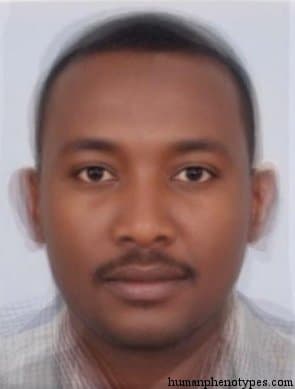
Composite source: Human Phenotypes — Middle Nile
Geographic Distribution
Middle Nile is documented across East Africa, with its historical reference center near 19.0° N, 30.0° E. The coordinates mark where the type was most characteristic roughly 1500 years ago; population movements since then have scattered and blended the distribution far beyond that point.
Physical Characteristics
Medium to dark brown skin, relatively fair for the region - a result of Orientalid admixture.
- Curly to kinky black hair
- Rather tall, brachyskelic, variable body type
- Dolicho- mesocephalic, orthocranic
- Meso- platyrrhine
- Overall features appear soft
Historical Background
The Middle Nile type is a contact type of the Nile Valley located in Northern Sudan. Features are variable, although North African, West Asian, and Sub-Saharan elements have a long history of contact in the region. In difference to the North Ethiopid Nubians of the region, it is characterised by a combination of Sudanid and Orientalid. Most common from Khartoum to Kosti and west to El Obeid, also in Kababish, Sudanese Arabs, and even Baqquara.
Research History & Naming
Every label in the historical catalogue has an author and a date, and Middle Nile has accumulated its share of competing attributions. For Middle Nile, the literature extract below shows the naming chain — from the first definition through the later revisions that shaped the current entry.
Eickstedt (1934) described it as a local contact type of North Africa: the second-easternmost type of the Saharan contact belt. Keane (1920) as a mixed Semite type, similarly Biasutti (1967) as Libyid-admixed. Detailed analysis by Seligman (1918) . The intermediate position was confirmed genetically by Tay and Saha (1988) .
Comparison With Nearby Phenotypes
Ranked by great-circle distance from Middle Nile's reference center, these are the five nearest documented phenotypes — the closest being East Sudanid at 782 km. Overlapping distributions like these are exactly what makes the quiz hard, and the East Sudanid row is where to start looking.
| Phenotype | Region | Distance | Distinguishing trait |
|---|---|---|---|
| East Sudanid | East Africa | 782 km | Dark brown, sometimes black skin, usually kinky hair. |
| Egyptid | North Africa | 793 km | Light brown skin, wavy or curly black hair. |
| North Ethiopid | East Africa | 914 km | Dark, sometimes medium (bronze) brown skin, tight-curly hair. |
| Proto Ethiopid | East Africa | 915 km | Dark, sometimes medium brown skin and kinky-curly hair. |
| Pre Nilotid | East Africa | 964 km | Black skin and kinky, sometimes tight-curly hair. |
Middle Nile in the Game
When the Middle Nile composite shows up in the quiz, players who know the East Africa distribution pattern have the edge. The reference answer sits near 19.0° N, 30.0° E; pins on the wrong continent score close to zero, so even a rough regional instinct beats a precise but misdirected pin.
Middle Nile Phenotype FAQ
- Where does the Middle Nile phenotype come from?
- The reference coordinates for the Middle Nile phenotype sit near 19.0° N, 30.0° E, in East Africa. That point marks the center of the East Africa distribution documented roughly 1500 years ago — actual prevalence spread well beyond it, toward entries such as East Sudanid 782 km away, and modern migration has blurred those boundaries further.
- What does the Middle Nile phenotype look like?
- In the historical literature, medium to dark brown skin, relatively fair for the region - a result of Orientalid admixture. For Middle Nile these are statistical tendencies across a population, not a checklist every individual matches.
- Is the Middle Nile phenotype a race or a nationality?
- No. Phenotypes like Middle Nile are descriptive averages, not ancestry groups. Middle Nile is one of several types documented in and around East Africa — see the comparison table above — and the same individual can carry traits associated with several of them at once. The Middle Nile entry describes a statistical pattern, not a group of people and not a nationality.
- How does Middle Nile appear in the game?
- In Classic Daily and Challenge Mode, the Middle Nile composite face appears without a label. Your task is to drop a pin on the world map where you think that face is historically most common — the scoring uses the distance between your pin and the reference coordinates near 19.0° N, 30.0° E. The post-round review then shows the correct location, your distance error, and this Middle Nile entry.
References & Literature
Primary sources for the Middle Nile entry, listed as cited in the historical literature. The naming and classification debates around Middle Nile referenced above run through these works.
- Eickstedt, E. von. 1934. Rassenkunde und Rassengeschichte der Menschheit. Ferdinand Enke. Stuttgart.
- Keane, A. H, Hingston Quiggin, A. and A.C. Haddon . 1920. Man, past and present. Cambridge University Press.
- Biasutti, R. 1967 (1941). Le Razze e i Popoli della terra. 4th Ed. Vol 1-4. U.T.E.T., Torino.
- Seligman, C. G. 1918. The Kababish. Harvard Afr. Studies 2.
- Tay, J. S. and N. Saha. 1988. Genetic heterogeneity among the Negroid and Arab tribes of the Sudan. American Journal of Physcial Anthropology 76, 2. 211-215.
Related Phenotypes
More entries from the same region of the historical map as Middle Nile, each with its own composite and trait profile.
East Sudanid
East Africa · 782 km away
Isolated Sudanid variety of the Nuba mountains in Kurdufan / Sudan, native to the region at least since the Neolithic. Has resisted historic...
Egyptid
North Africa · 793 km away
Libyid variety, typical for the Nile Valley of Egypt. May result from ancient South/West Asian migrations that mixed with native Berberids. ...
North Ethiopid
East Africa · 914 km away
Ethiopid subtype that is often regarded as a northern branch of East Ethiopid. Common along the Red Sea coast and the Nile Valley from Egypt...
Proto Ethiopid
East Africa · 915 km away
Ancient type that inhabited the Southwestern Eritrean lowlands prior to the arrival of Ethiopids, and possibly resembles early "Out of Afric...
Pre Nilotid
East Africa · 964 km away
Ancient type with Proto Nilotid traits, today still found in the border region of Sudan and Ethiopia. Common in Kwama, Uduk, Gumuz, Mao, and...
Further Reading
Background articles from the blog that explain where the Middle Nile type fits, how these composites are built, and what a face can and cannot tell you.
What Country Do I Look Like: The Count Comes Before the Face
Which country a face resembles depends on which official list you are using, and the world publishes several that disagree on how many...
Guess Ethnicity From a Photo: What Gets Measured First
Before a face model names anything, it measures. Here is the geometry stage: the landmark schemes tools rely on, the photo standards...