Chocó-Motilon Phenotype - Face Features & Origin
Special type found in Colombia, Venezuela, as well as Panama. The entry below collects the Chocó-Motilon composite face, its documented distribution around 15.0° S, 60.0° W in South America, its physical characteristics, the research history behind the name, and the academic references that support all of it.
Average Face
The composite below is not a photograph of a real person. Historical anthropologists aligned multiple individual portraits from the Chocó-Motilon reference population and averaged them into one image, so recurring structures — skull outline, nose form, lip thickness, brow position — dominate while individual idiosyncrasies cancel out.
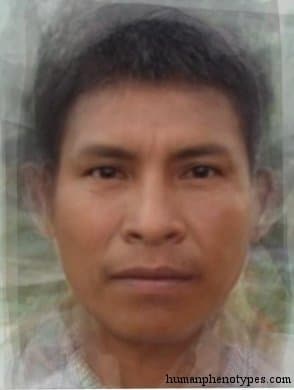
Composite source: Human Phenotypes — Chocó-Motilon
Geographic Distribution
The reference center for Chocó-Motilon sits near 15.0° S, 60.0° W in South America. Around that anchor, prevalence falls off gradually — the type is not confined to one valley or one modern border, and the historical map should be read as a gradient rather than a boundary.
Physical Characteristics
Medium brown skin with straight or wavy hair.
- Short, macroskelic, endomorph to ectomorph
- Mesocephalic, chamae- orthocranic, mesorrhine nose with a slightly depressed root
- The face is relatively high and long, the supraorbital arches are visible
- Eyes narrow, lips rather full
- The chin is often receding
Historical Background
Special type found in Colombia, Venezuela, as well as Panama. Contains Brasilid elements as well as relicts of one of the first migrations to South America that show similarities to Fuegids. Typical groups include Chocó (Embera, Wounaan), Motilon (Barí, Yukpa) and some related people, many of them extinct today. Was also present in Pre-Columbian Ecuadorian cultures.
Research History & Naming
The name "Chocó-Motilon" carries its own history. The passage below traces who first defined the type, which rival names competed with it, and how later authors consolidated or disputed the classification — the raw material of any serious phenotype reference.
The type was described as a Fuegoid-influenced element by Biasutti (1967) . Lundman (1967) reported similar types on the coasts of Ecuador, Venezuela, and South of the Maracaibo lake. Imbelloni (1958) noted Fuegid as well as Lagid admixed groups in the area.
Comparison With Nearby Phenotypes
The five phenotypes whose documented centers lie closest to Chocó-Motilon, ranked by great-circle distance. They are the types players most often confuse with Chocó-Motilon in the quiz, precisely because their distributions overlap.
| Phenotype | Region | Distance | Distinguishing trait |
|---|---|---|---|
| Bororo | South America | 0 km | Olive medium brown skin with straight and black rarely wavy hair. |
| Botocudo | South America | 0 km | Yellowish/copperish light brown skin with straight or wavy hair. |
| Central Andid | South America | 0 km | Medium olive-brown skin, straight, rarely wavy hair. |
| Huarpid | South America | 0 km | Medium, sometimes dark brown skin, often with wavy hair. |
| Isthmid | South America | 0 km | Medium (yellowish) brown skin, straight or slightly wavy hair. |
Chocó-Motilon in the Game
Chocó-Motilon is one of the faces that can appear in Classic Daily and Challenge Mode. When it does, the winning pin lands near 15.0° S, 60.0° W in South America — and because the scoring decays with distance, recognizing the region matters more than pixel-perfect placement.
Chocó-Motilon Phenotype FAQ
- Where does the Chocó-Motilon phenotype come from?
- Historical sources center the Chocó-Motilon phenotype on 15.0° S, 60.0° W (South America). Treat that as a rough anchor: the type appeared across a wider surrounding area — its nearest documented neighbor, Bororo, shares its reference point in the historical dataset, with Botocudo 0 km further out — and its present-day distribution no longer matches the historical map.
- What does the Chocó-Motilon phenotype look like?
- The composite emphasizes recurring traits: medium brown skin with straight or wavy hair. The full trait list for Chocó-Motilon appears in the physical characteristics section above.
- Is the Chocó-Motilon phenotype a race or a nationality?
- No — and the naming history above shows why. Chocó-Motilon was defined, renamed, and regrouped repeatedly by different researchers, which is the opposite of how a fixed racial category would behave. A phenotype is a recurring bundle of visible traits recorded across a population; the label says nothing about where any individual's ancestors were born.
- How does Chocó-Motilon appear in the game?
- When the Chocó-Motilon face comes up in Classic Daily or Challenge Mode, you pin the world map where you believe the type is historically most common, and the score decays with your distance to 15.0° S, 60.0° W. Fair warning: the nearest other entry in our dataset, Bororo, shares the same reference point, so this part of the map is crowded with overlapping types — precision, not just the right country, wins points.
References & Literature
The Chocó-Motilon phenotype entry above is compiled from the following academic references. Readers are encouraged to consult the original sources for verification and deeper context.
- Biasutti, R. 1967 (1941). Le Razze e i Popoli della terra. 4th Ed. Vol 1-4. U.T.E.T., Torino.
- Lundman, B. 1967. Geographische Anthropologie. Rassen und Völker der Erde. G. Fischer, Stuttgart
- Imbelloni, J. 1958. Nouveaux apports à la classification de l'homme américain. Miscellanea P. Rivet octogenario dicata. Mexico.
Related Phenotypes
If Chocó-Motilon interested you, these neighboring phenotype entries cover adjacent parts of the map with distinctly different trait bundles.
Bororo
South America · 0 km away
The northernmost Patagonid variety, often mixed with local Lagid elements, but with a variety of unique features. Native to the savannah and...
Botocudo
South America · 0 km away
Lagid subtype of the Mata Atlântica forests of Brazil, partially mixed with the Fuegid substratum (South Fuegids, Huarpids). Was the dominan...
Central Andid
South America · 0 km away
Andid variety, mostly native the Andes mountains from South Peru to Northern Chile. The large thorax and other traits indicate a significant...
Huarpid
South America · 0 km away
Northern Fuegid variety that is often considered part of the Lagoid group. Shows Melanesiform features and probably arrived with one of the ...
Isthmid
South America · 0 km away
Centralid subtype, that has partially adapted to the tropical forests of the Isthmus of Panama and the surrounding regions from Colombia to ...
Further Reading
Background articles from the blog that explain where the Chocó-Motilon type fits, how these composites are built, and what a face can and cannot tell you.
What Ethnicity Am I? Three Ways to Actually Answer It
The question is personal, but the answers arrive from three different places: records, DNA, and appearance.
Ethnic Guesser: Which Facial Cues Actually Decide a Round
A round of the game turns on a handful of facial cues, and they are not equal. Here is how pigment, the epicanthic fold, nasal shape...