Malagasid Phenotype - Face Features & Origin
Relatively recent Bantuid-South Mongolid contact type native to the island of Madagascar. Its reference coordinates sit near 18.9° S, 46.4° E in Sub-Saharan Africa. Rather than a single portrait, the Malagasid composite below is a statistical average, and the surrounding sections — traits, distribution, research history, references — give that average its context.
Average Face
What you see below is a statistical construction of the Malagasid reference population. Faces recorded from the Malagasid sample were overlaid and merged; the result keeps the features most members shared and discards personal variation. It reads like a Malagasid portrait, but it works like a histogram.
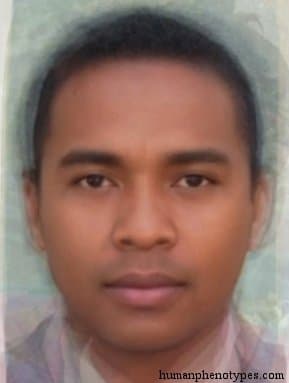
Composite source: Human Phenotypes — Malagasid
Geographic Distribution
The reference center for Malagasid sits near 18.9° S, 46.4° E in Sub-Saharan Africa. Around that anchor, prevalence falls off gradually — the type is not confined to one valley or one modern border, and the historical map should be read as a gradient rather than a boundary.
Physical Characteristics
Medium brown skin and often (tight-)curly hair.
- Medium height, meso-, sometimes brachyskelic, variable body type
- Mesocephalic, mildly hypsicranic
- Meso- platyrrhine nose that is not very prominent
- Sporadically slanting eyes, prognathy absent, hairiness weak
Historical Background
Relatively recent Bantuid-South Mongolid contact type native to the island of Madagascar. Formed when Malay immigrants from the Sunda Islands met Bantu from East Africa some millennia ago. Arabid and Indid elements entered as well. The type shares the island with Bantuids, full South Mongolids, and even some Veddoids. Common in Sihanka, Betsileo, Betsimisaraka, Tsimihety, Sakalava, etc.
Research History & Naming
Every label in the historical catalogue has an author and a date, and Malagasid has accumulated its share of competing attributions. For Malagasid, the literature extract below shows the naming chain — from the first definition through the later revisions that shaped the current entry.
Named and defined by Biasutti (1967) as Malgascia, who noted superficial similarities to Ethiopids. Also used by Glinka (1981) in a similar way. Others described the groups as Bantuid-South Mongolid blends ( Eickstedt, 1934 ; Lundman, 1967 ). These two main contributing elements can be confirmed genetically ( Pierron et al. 2013 ). Detailed investigation by Chabeuf (1989) .
Comparison With Nearby Phenotypes
The five phenotypes whose documented centers lie closest to Malagasid, ranked by great-circle distance. They are the types players most often confuse with Malagasid in the quiz, precisely because their distributions overlap.
| Phenotype | Region | Distance | Distinguishing trait |
|---|---|---|---|
| Central Bantuid | Sub-Saharan Africa | 1,759 km | Dark brown, sometimes black skin, usually kinky, sometimes peppercorn hair. |
| Sandawe | East Africa | 1,830 km | Usually medium brown skin and kinky or peppercorn hair. |
| South Bantuid | Sub-Saharan Africa | 1,905 km | Dark, sometimes medium brown skin, usually kinky, sometimes peppercorn hair. |
| Hadza | East Africa | 2,102 km | Dark brown to black skin with kinky hair. |
| Katangid | Sub-Saharan Africa | 2,220 km | Medium to dark brown skin, curly to kinky hair. |
Malagasid in the Game
Malagasid is one of the faces that can appear in Classic Daily and Challenge Mode. When it does, the winning pin lands near 18.9° S, 46.4° E in Sub-Saharan Africa — and because the scoring decays with distance, recognizing the region matters more than pixel-perfect placement.
Malagasid Phenotype FAQ
- Where does the Malagasid phenotype come from?
- Historical sources center the Malagasid phenotype on 18.9° S, 46.4° E (Sub-Saharan Africa). Treat that as a rough anchor: the type appeared across a wider surrounding area — its nearest documented neighbors, Central Bantuid and Sandawe, sit 1,759 and 1,830 km from the reference point — and its present-day distribution no longer matches the historical map.
- What does the Malagasid phenotype look like?
- The composite emphasizes recurring traits: medium brown skin and often (tight-)curly hair. The full trait list for Malagasid appears in the physical characteristics section above.
- Is the Malagasid phenotype a race or a nationality?
- No — and the Malagasid naming history above shows why. Malagasid was defined, renamed, and regrouped repeatedly by different researchers, which is the opposite of how a fixed racial category would behave. A phenotype is a recurring bundle of visible traits recorded across a population; the Malagasid label says nothing about where any individual's ancestors were born.
- How does Malagasid appear in the game?
- When the Malagasid face comes up in Classic Daily or Challenge Mode, you pin the world map where you believe the type is historically most common, and the score decays with your distance to 18.9° S, 46.4° E. The nearest documented type, Central Bantuid, lies 1,759 km away — an isolated reference point, so even a broad regional answer scores respectably here.
References & Literature
Primary sources for the Malagasid entry, listed as cited in the historical literature. The naming and classification debates around Malagasid referenced above run through these works.
- Biasutti, R. 1967 (1941). Le Razze e i Popoli della terra. 4th Ed. Vol 1-4. U.T.E.T., Torino.
- Glinka, J. 1987. Antropologi Ragawi Handout Mahasiswa. Surabaya: FISIP Universitas Airlangga.
- Eickstedt, E. von. 1934. Rassenkunde und Rassengeschichte der Menschheit. Ferdinand Enke. Stuttgart.
- Lundman, B. 1967. Geographische Anthropologie. Rassen und Völker der Erde. G. Fischer, Stuttgart
- P13b
- Chabeuf, M. 1989. Le peuplement de Madagascar. In: Schwidetzky, I. Rassengeschichte der Menschheit 13. Afrika II. Südafrika. R. Oldenburg. Verlag München.
Related Phenotypes
Other human phenotypes whose documented centers lie in the same part of the map as Malagasid.
Central Bantuid
Sub-Saharan Africa · 1,759 km away
Bantuid variety, characterised by elongated features and strong dolichocephaly. Found especially in Mozambique and Zimbabwe, also Malawi, Na...
Sandawe
East Africa · 1,830 km away
Distinctive East African type of the Tanzanian savannahs, especially the Dodoma region. A relict of Khoisanid populations that were more wid...
South Bantuid
Sub-Saharan Africa · 1,905 km away
Bantuid variety, characterised by relatively wide skulls and robust faces. Especially found in the Kwazulu Natal / Transkei regions of South...
Hadza
East Africa · 2,102 km away
Ancient type of the Tanzanian Bushmen, living close to Lake Eyasi. Very distinct from any other type in the world and has probably long been...
Katangid
Sub-Saharan Africa · 2,220 km away
Very ancient Australiform African type. Probably more widespread during the Paleolithic, only survives as a rare minority element. May still...
Further Reading
Background articles from the blog that explain where the Malagasid type fits, how these composites are built, and what a face can and cannot tell you.
Free Ethnicity Guesser: What Free Actually Costs
The phrase covers a quiz, a photo classifier and a reference library. What separates them is not the price but how each is funded, and...
AI Ethnicity Test: What a Measurement Would Require
A laboratory test has a reference standard, a defined construct and a published error bar. A face-based ethnicity tool owns none of...