South Bantuid Phenotype - Face Features & Origin
Bantuid variety, characterised by relatively wide skulls and robust faces. The entry below collects the South Bantuid composite face, its documented distribution around 28.5° S, 30.9° E in Sub-Saharan Africa, its physical characteristics, the research history behind the name, and the academic references that support all of it.
Average Face
The South Bantuid composite below is not a photograph of a real person. Historical anthropologists aligned multiple individual portraits from the South Bantuid reference population and averaged them into one image, so recurring structures — skull outline, nose form, lip thickness, brow position — dominate while individual idiosyncrasies cancel out.
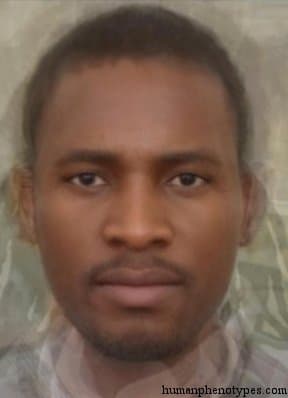
Composite source: Human Phenotypes — South Bantuid
Geographic Distribution
The reference center for South Bantuid sits near 28.5° S, 30.9° E in Sub-Saharan Africa. Around that anchor, prevalence falls off gradually — the type is not confined to one valley or one modern border, and the historical map should be read as a gradient rather than a boundary.
Physical Characteristics
Dark, sometimes medium brown skin, usually kinky, sometimes peppercorn hair.
- (Rather) tall, mildly brachyskelic, endo- mesomorph
- Dolicho- mesocephalic, orthocranic, sometimes chamaecranic
- Slightly narrower, more robust faces than other Bantuids, hairiness stronger, eyes more deep-set, brow ridges may be present
- Platyrrhine nose, mouth large
- Prognathy mild, chin sometimes receding
Historical Background
Bantuid variety, characterised by relatively wide skulls and robust faces. Especially found in the Kwazulu Natal / Transkei regions of South Africa and Swaziland, extends through many regions of Southern Africa and Madagascar. Originated from Bantu expansion some millennia ago. Typified by Zulu, Swazi, Bhaca, also in Makua, Kwanyama, Hlubi, Fengu, Ovambo, Pondo and many more, spread to Namibia in the Middle Ages (e.g. Damara, sometimes Herero).
Research History & Naming
Every label in the historical catalogue has an author and a date, and South Bantuid has accumulated its share of competing attributions. For South Bantuid, the literature extract below shows the naming chain — from the first definition through the later revisions that shaped the current entry.
Named South Bantuid by Eickstedt (1934) and kept later as South Kaffrid ( Eickstedt, 1951 ; Schwidetzky, 1965 ; Hirschberg, 1974 ). Lundman (1967) highlighted differences to other Bantuids. Corresponds with Dart's (1962) Bhaca-Swazi-Zulu "group B". Also called Zambesid ( Vallois, 1971 ).
Comparison With Nearby Phenotypes
Geography, not alphabet, ordered this table: the five phenotype centers closest to South Bantuid's, with the traits most likely to be mistaken for it (Fengu-Pondo leads at 398 km). In gameplay, these five account for most of the wrong-but-nearby pins against South Bantuid.
| Phenotype | Region | Distance | Distinguishing trait |
|---|---|---|---|
| Fengu-Pondo | Sub-Saharan Africa | 398 km | Yellowish dark, sometimes medium brown skin, usually kinky, sometimes peppercorn hair. |
| Xhosaid | Sub-Saharan Africa | 580 km | Medium to dark yellowish-brown skin with kinky or peppercorn hair. |
| Chopi-Tswana | Sub-Saharan Africa | 865 km | Yellowish dark, sometimes medium brown skin, usually kinky, sometimes peppercorn hair. |
| Karroid | Sub-Saharan Africa | 871 km | Yellowish light or medium brown skin, heavily wrinkled in old age, peppercorn hair. |
| Kalaharid | Sub-Saharan Africa | 1,080 km | Yellowish/reddish medium brown skin, wrinkled in old age, peppercorn hair (< 15 mm). |
South Bantuid in the Game
In gameplay terms, South Bantuid rewards region-level recall: the score is computed from the distance between your pin and 28.5° S, 30.9° E. Players often confuse South Bantuid with Fengu-Pondo (398 km out) in the comparison table above — those confusions are exactly what the distance penalty is designed to expose.
South Bantuid Phenotype FAQ
- Where does the South Bantuid phenotype come from?
- Historical sources center the South Bantuid phenotype on 28.5° S, 30.9° E (Sub-Saharan Africa). Treat that as a rough anchor: the type appeared across a wider surrounding area — its nearest documented neighbors, Fengu-Pondo and Xhosaid, sit 398 and 580 km from the reference point — and its present-day distribution no longer matches the historical map.
- What does the South Bantuid phenotype look like?
- The composite emphasizes recurring traits: dark, sometimes medium brown skin, usually kinky, sometimes peppercorn hair. The full trait list for South Bantuid appears in the physical characteristics section above.
- Is the South Bantuid phenotype a race or a nationality?
- No — and the South Bantuid naming history above shows why. South Bantuid was defined, renamed, and regrouped repeatedly by different researchers, which is the opposite of how a fixed racial category would behave. A phenotype is a recurring bundle of visible traits recorded across a population; the South Bantuid label says nothing about where any individual's ancestors were born.
- How does South Bantuid appear in the game?
- When the South Bantuid face comes up in Classic Daily or Challenge Mode, you pin the world map where you believe the type is historically most common, and the score decays with your distance to 28.5° S, 30.9° E. Fair warning: the nearest other entry in our dataset, Fengu-Pondo, sits just 398 km away, so this face rewards precise placement — the right country alone is not always enough.
References & Literature
Primary sources for the South Bantuid entry, listed as cited in the historical literature. The naming and classification debates around South Bantuid referenced above run through these works.
- Eickstedt, E. von. 1934. Rassenkunde und Rassengeschichte der Menschheit. Ferdinand Enke. Stuttgart.
- Eickstedt, E. von 1951. Die Träger der Afrikanischen Kulturen. In: Bernatzik, H. Afrika. Handbuch der angewandten Völkerkunde. F. Bruckmann. München.
- Schwidetzky, I. 1965. Variations- und Typenkunde des Menschen. In: Lundwig, B. and H. Plank. Handbuch der Biologie. Vol 9 (2).
- Hirschberg, W. 1974. Die Kulturen Afrikas. Handbuch der Kulturgeschichte. Kulturen der Völker. Akademisch Verlagsgesellschaft Athenaion. Frankfurt a. M.
- Lundman, B. 1967. Geographische Anthropologie. Rassen und Völker der Erde. G. Fischer, Stuttgart
- Dart, R.A. 1962. Racial Origins. In: Schapera, I.. The Bantu Speaking Tribes of South Africa. Routledge & Kegan Paul. London.
- Vallois, H. V. 1971. Las races humaines. 8 Ed. Grammont.
Related Phenotypes
If South Bantuid interested you, these neighboring phenotype entries cover adjacent parts of the map with distinctly different trait bundles.
Fengu-Pondo
Sub-Saharan Africa · 398 km away
Bantuid variety, similar to South Bantuid, but with weak Khoisan influence, placing it closer to Xhosaid. Developed as a result of the Bantu...
Xhosaid
Sub-Saharan Africa · 580 km away
Bantuid-Khoisan contact type that developed as a result of the Bantu expansion some millennia ago when Bantu assimilated older Khoisan group...
Chopi-Tswana
Sub-Saharan Africa · 865 km away
Bantuid variety, overall similar to Central Bantuid, but with weak Khoisan influence, placing it closer to Xhosaid. Developed as a result of...
Karroid
Sub-Saharan Africa · 871 km away
Sanid variety, named after the Karoo desert. Very ancient and distinct with many unique features. Was dominant in Southern Africa some centu...
Kalaharid
Sub-Saharan Africa · 1,080 km away
Sanid variety, native to the Kalahari. Very ancient and distinct, specialised desert type with many unique features. Typical for the Norther...
Further Reading
Background articles from the blog that explain where the South Bantuid type fits, how these composites are built, and what a face can and cannot tell you.
AI Ethnicity Test: What a Measurement Would Require
A laboratory test has a reference standard, a defined construct and a published error bar. A face-based ethnicity tool owns none of...
Geography Games Like GeoGuessr: Six Kinds of Clue
Street panoramas, country outlines and average faces all answer one question. Here are six geography games sorted by the clue they hand...