North Andamanid Phenotype - Face Features & Origin
Almost extinct, isolated type endemic to the Andaman Islands. Its reference coordinates sit near 12.6° N, 92.8° E in South Asia. Rather than a single portrait, the North Andamanid composite below is a statistical average, and the surrounding sections — traits, distribution, research history, references — give that average its context.
Average Face
What you see below is a statistical construction of the North Andamanid reference population. Faces recorded from the North Andamanid sample were overlaid and merged; the result keeps the features most members shared and discards personal variation. It reads like a North Andamanid portrait, but it works like a histogram.
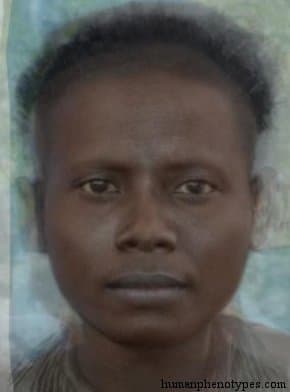
Composite source: Human Phenotypes — North Andamanid
Geographic Distribution
North Andamanid is documented across South Asia, with its historical reference center near 12.6° N, 92.8° E. The coordinates mark where the type was most characteristic roughly 1500 years ago; population movements since then have scattered and blended the distribution far beyond that point.
Physical Characteristics
Brown-blackish skin, kinky or peppercorn hair, very short (males 147 cm), mesoskelic, ectomorph, body proportions show no sign of pygmyism.
- Mildly brachycephalic, mildly hypsicranic, small-headed
- Mesorrhine
- Similar to the South Andamanid, but more gracile with a longer face, thinner nose, and a lower cephalic index
- Face shows several Caucasiform traits
- Chin weak, prognathy mild
Historical Background
Almost extinct, isolated type endemic to the Andaman Islands. Particularly in Great Andamanese groups, rarer in other Andamanese. After contact with Europeans in the 19th century the population collapsed, mostly due to disease. Only about a dozen Great Andamanese remain today, several of them are mixed.
Research History & Naming
Typological names were coined, contested, and renamed repeatedly across the 20th century, and North Andamanid is no exception. The extract below records the researchers who defined North Andamanid, the alternative labels it accumulated, and where the modern consensus settled.
During his expeditions, Eickstedt (1928) found the Great Andanamese variety to be anthropometrically distinct from Little Andamanese. Biasutti followed in recognising an Onghi subvariety of Andamasese ( Biasutti (1967) ). Modern research has confirmed the genealogical distinctiveness (Abbi, 2008) . Often simply regarded as Andamanid ( Lundman, 1967 ; Alexeev, 1979 ; Knussmann, 1996 )
Comparison With Nearby Phenotypes
Geography, not alphabet, ordered this table: the five phenotype centers closest to North Andamanid's, with the traits most likely to be mistaken for it (South Andamanid leads at 215 km). In gameplay, these five account for most of the wrong-but-nearby pins against North Andamanid.
| Phenotype | Region | Distance | Distinguishing trait |
|---|---|---|---|
| South Andamanid | South Asia | 215 km | Bluish brown-black skin, kinky or peppercorn hair. |
| Shanid | Southeast Asia | 1,013 km | Yellowish light to medium brown skin with straight, sometimes wavy hair. |
| East Shanid | Southeast Asia | 1,079 km | Yellowish light to medium brown skin with straight, sometimes wavy hair. |
| Palaungid | Southeast Asia | 1,132 km | Yellowish-reddish light to medium brown skin with straight or wavy hair. |
| Jahai Semangid | Southeast Asia | 1,246 km | Dark (copper) brown skin and kinky hair. |
North Andamanid in the Game
In gameplay terms, North Andamanid rewards region-level recall: the score is computed from the distance between your pin and 12.6° N, 92.8° E. Players often confuse North Andamanid with South Andamanid (215 km out) in the comparison table above — those confusions are exactly what the distance penalty is designed to expose.
North Andamanid Phenotype FAQ
- Where does the North Andamanid phenotype come from?
- Historical sources center the North Andamanid phenotype on 12.6° N, 92.8° E (South Asia). Treat that as a rough anchor: the type appeared across a wider surrounding area — its nearest documented neighbors, South Andamanid and Shanid, sit 215 and 1,013 km from the reference point — and its present-day distribution no longer matches the historical map.
- What does the North Andamanid phenotype look like?
- The composite emphasizes recurring traits: brown-blackish skin, kinky or peppercorn hair, very short (males 147 cm), mesoskelic, ectomorph, body proportions show no sign of pygmyism. The full trait list for North Andamanid appears in the physical characteristics section above.
- Is the North Andamanid phenotype a race or a nationality?
- No. A phenotype is a recurring bundle of visible traits documented by historical anthropologists across a population — for North Andamanid, patterns such as brown-blackish skin, kinky or peppercorn hair, very short (males 147 cm), mesoskelic, ectomorph, body proportions show no sign of pygmyism. The North Andamanid entry is not a genetic ancestry, not a nationality, and not a statement about any individual person. Two people from the same country can match completely different phenotypes — one resembling North Andamanid, another closer to South Andamanid — and one phenotype can span many modern borders.
- How does North Andamanid appear in the game?
- When the North Andamanid face comes up in Classic Daily or Challenge Mode, you pin the world map where you believe the type is historically most common, and the score decays with your distance to 12.6° N, 92.8° E. Fair warning: the nearest other entry in our dataset, South Andamanid, sits just 215 km away, so this face rewards precise placement — the right country alone is not always enough.
References & Literature
Every claim on this page traces back to the sources below — the researchers who defined, measured, and argued over the North Andamanid type. The originals behind the North Andamanid entry are worth consulting directly.
- Eickstedt, E. von. 1928. Das Rassenbild des westlichen und zentralen Hinterindien. In: Anthropologischer Anzeiger (5), 176-187.
- Biasutti, R. 1967 (1941). Le Razze e i Popoli della terra. 4th Ed. Vol 1-4. U.T.E.T., Torino.
- Abbi A. 2008. Is Great Andamanese genealogically and typologically distinct from Onge and Jarawa? Language Sciences.
- Lundman, B. 1967. Geographische Anthropologie. Rassen und Völker der Erde. G. Fischer, Stuttgart
- Alexeev, V. P. 1979. The Differential Geography of Races. In: Stini, W. A. Physiological and Morphological Adaptation and Evolution. De Gruyter.
- Knussmann, R. 1996. Vergleichende Biologie des Menschen: Lehrbuch der Anthropologie und Humangenetik. 2ed. Spektrum Akademischer Verlag.
Related Phenotypes
Other human phenotypes whose documented centers lie in the same part of the map as North Andamanid.
South Andamanid
South Asia · 215 km away
Isolated type typical for the Little Andamanese people (Onge, Jarawa, Sentilese). After contact with Europeans in the 19th century populatio...
Shanid
Southeast Asia · 1,013 km away
Sinoid South Mongolid type, typical in the (Irrawaddy) plains and the Shan Plateau of Myanmar. The name derives from the Shan people, who mi...
East Shanid
Southeast Asia · 1,079 km away
Eastern variety of Shanid, weakly influenced by Veddid. Typical for the plains and river valleys of Indochina, especially from North Thailan...
Palaungid
Southeast Asia · 1,132 km away
The proper Palaungid variety, typical for the Central Burmese hill tribes, also in Yunnan, Himalaya, South Tibet, Thailand, and parts of Ind...
Jahai Semangid
Southeast Asia · 1,246 km away
Semangid variety, a Paleolithic relict of the original Malaysian forest population. Shows more Veddoid/Australoid features and is similar to...
Further Reading
Background articles from the blog that explain where the North Andamanid type fits, how these composites are built, and what a face can and cannot tell you.
AI Ethnicity Analyzer: Four Instruments, One Name
An analyzer implies parts, but four quite different machines trade under that name: a label classifier, a geometry tool, an embedding...
Guess Ethnicity From a Photo: What Gets Measured First
Before a face model names anything, it measures. Here is the geometry stage: the landmark schemes tools rely on, the photo standards...